
Ein spielbares 3D-Spiel, aus einem einzigen Prompt gebaut
Spielentwicklung ist eine der technisch anspruchsvollsten kreativen Disziplinen — sie erfordert, dass Physik, Rendering, KI, Zustandsverwaltung und UI alle in einer einzigen Codebasis zusammenarbeiten. Dieser Workflow zeigt, dass Eigent mit einem ausreichend detaillierten Prompt und Gemini 3.1 Pro Preview ein vollständig spielbares Browser-Spiel mit mehreren Dateien spezifizieren, schreiben und ausliefern kann — ganz ohne eine einzige Zeile manuellen Code.
Gemini 3.1 Pro Preview konfigurieren
Dieser Workflow läuft auf Gemini 3.1 Pro Preview, Googles leistungsfähigstem Modell zum Zeitpunkt der Aufnahme. Um es in Eigent zu konfigurieren, gehe zu Einstellungen → Modelle → Benutzerdefinierte Modelle:
- API Host:
https://generativelanguage.googleapis.com/v1beta/openai/ - Modell:
gemini-3.1-pro-preview
Eigent unterstützt mehrere benutzerdefinierte Modelle gleichzeitig — du kannst Gemini, OpenAI, Anthropic, Qwen, Deepseek, MiniMax und andere alle gleichzeitig konfigurieren, wobei eines als aktives Standardmodell festgelegt ist.
Der Game-Design-Prompt
Ein detaillierter Prompt erzeugt ein detailliertes Ergebnis. Dieser hier spezifiziert Mechaniken, visuellen Stil, Punktesystem, besondere Events und sogar eine konkrete Sammelsequenz:
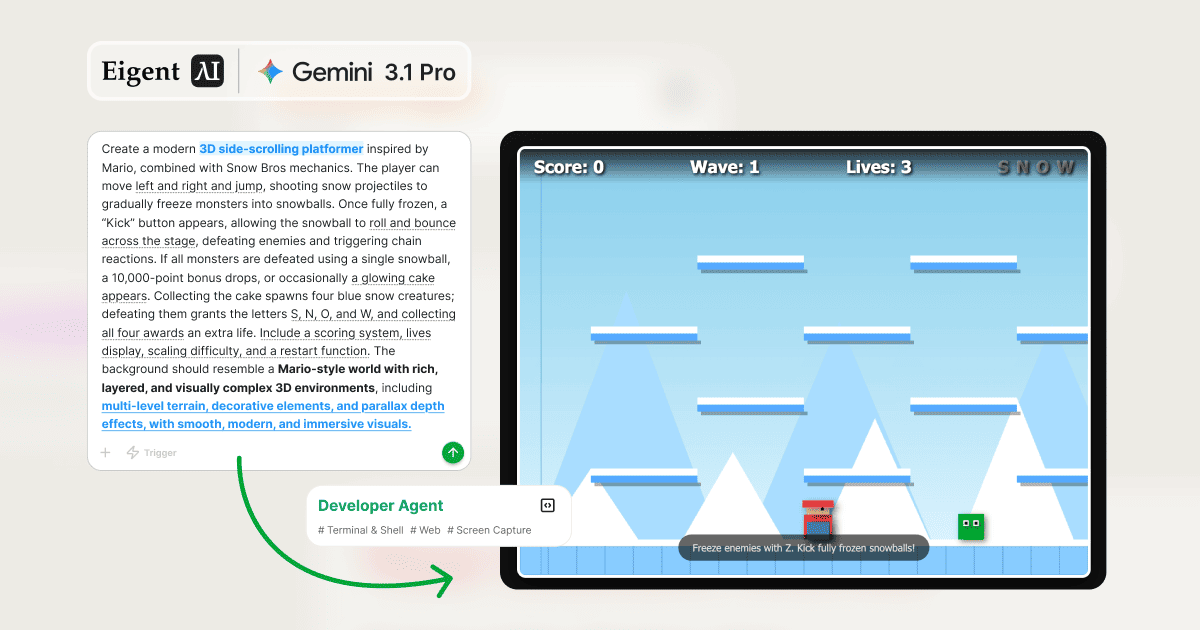
Erstelle einen modernen 3D-Side-Scrolling-Platformer, inspiriert von Mario, kombiniert mit Snow Bros-Mechaniken. Der Spieler kann sich nach links und rechts bewegen und springen sowie Schneegeschosse abfeuern, um Monster nach und nach in Schneebälle einzufrieren. Sobald sie vollständig eingefroren sind, erscheint eine „Kick“-Schaltfläche, die es ermöglicht, dass der Schneeball über das Spielfeld rollt und springt, Gegner besiegt und Kettenreaktionen auslöst. Wenn alle Monster mit nur einem Schneeball besiegt werden, fällt ein Bonus von 10.000 Punkten oder gelegentlich erscheint ein leuchtender Kuchen. Das Einsammeln des Kuchens lässt vier blaue Schneekreaturen erscheinen; das Besiegen dieser Kreaturen gewährt die Buchstaben S, N, O und W, und wer alle vier sammelt, erhält ein zusätzliches Leben. Integriere ein Punktesystem, eine Lebensanzeige, skalierende Schwierigkeit und eine Neustartfunktion. Der Hintergrund soll einer Mario-ähnlichen Welt ähneln, mit reichen, geschichteten und visuell komplexen 3D-Umgebungen, einschließlich mehrstufigem Terrain, dekorativen Elementen und Parallax-Tiefeffekten, mit flüssiger, moderner und immersiver Optik.
Jede im Prompt genannte Mechanik ist im Ergebnis implementiert.
Eigent plant und führt den Build aus
Eigent erstellt eine einzelne Aufgabe für den Developer Agent:
Entwickle ein vollständig spielbares HTML5-/JavaScript-Webspiel mit Three.js, das moderne 3D-Side-Scrolling-Platformer-Optik mit Snow Bros-Gameplay-Mechaniken kombiniert — einschließlich Schneegeschoss-Schießen, Einfrieren und Treten von Gegnern, Kettenreaktions-Boni, Punktesystem, Leben, skalierender Schwierigkeit und einer Neustartfunktion.
Der Developer Agent nutzt Terminal- und Shell-Tools sowie Web Deployment- und Screen-Capture-Funktionen, um alle Spieldateien direkt in den Workspace-Ordner zu schreiben.
Drei Dateien, ein vollständiges Spiel
Die Ausgabe besteht aus drei voneinander abhängigen Dateien:
index.html— Einstiegspunkt und Spielcontainergame.js— die gesamte Spiellogik: Three.js-Rendering-Pipeline, Physik, Zustandsmaschine der Gegner-KI, Projektilsystem, Erkennung von Kettenreaktionen, Bonus-Drop-Logik, Punktesystem, Lebensverwaltung und die Sammelsequenz der SNOW-Buchstabenstyle.css— Canvas-Größenanpassung, UI-Overlays, HUD-Styling
Der Three.js-Renderer baut eine geschichtete 3D-Umgebung mit Parallax-Tiefe auf — Schneeberge im Hintergrund, Plattformen im Mittelgrund und Gelände im Vordergrund, alles mit prozeduralen Canvas-Elementen und flüssiger Animation.
Wie das fertige Spiel aussieht
Das Öffnen von index.html in jedem modernen Browser zeigt einen vollständig spielbaren Platformer:
- HUD: Punktestand, Wellenzähler, Lebensanzeige und der S-N-O-W-Buchstaben-Fortschrittsbalken
- Spielersteuerung: Bewegung nach links/rechts, Springen, Schneegeschosse abfeuern
- Gegnermechaniken: Fortschreitender Gefrierzustand, Kick-zum-Rollen, Kettenreaktion, wenn ein Schneeball mehrere Gegner trifft
- Bonussystem: Bonus von 10.000 Punkten bei einem vollständigen Durchlauf mit nur einem Schneeball
- Visueller Stil: 3D-geschichteter Schneeberg-Hintergrund, Mario-artiges Leveldesign, flüssiges Parallax-Scrolling
Tooltip beim ersten Laden: "Friere Gegner mit Z ein. Tritt vollständig eingefrorene Schneebälle!"
Verwendete Token insgesamt: ungefähr 147.000 — sparsam für ein mehrteiliges Spiel dieser Komplexität.
Was das über KI-gestützte Spieleentwicklung zeigt
Die Snow Bros-Mechanik — einfrieren, treten, Kette — erfordert, dass der Agent voneinander abhängige Spielzustände implementiert: Ein Gegner kann nicht eingefroren, teilweise eingefroren oder vollständig eingefroren sein und erst in genau einem bestimmten Zustand zu einem rollbaren Schneeball werden. Die Logik der Kettenreaktion erfordert eine Kollisionserkennung zwischen einem rollenden Schneeball und anderen Gegnern. Das sind keine trivialen Implementierungen.
Die Fähigkeit von Gemini 3.1 Pro, die gesamte Spielspezifikation im Kontext zu halten und kohärentes, voneinander abhängiges JavaScript über mehrere Dateien hinweg zu erzeugen, macht dies möglich. Das Ergebnis ist kein Template — es ist eine individuelle Implementierung der exakt beschriebenen Mechaniken.
Was du als Nächstes ausprobieren solltest
Füge eine zweite spielbare Figur mit anderen Projektilmechaniken und einem lokalen Zwei-Spieler-Modus hinzu.
Generiere einen Level-Editor, mit dem du Plattformen und Gegner auf einem Raster platzieren und das Layout als JSON exportieren kannst.
Füge eine Highscore-Rangliste hinzu, die in localStorage gespeichert bleibt.
Erstelle eine Mobile-Version mit Touch-Steuerung für dasselbe Spiel.
Tipps für bessere Ergebnisse
-
Beschreibe Mechaniken präzise. Die Freeze → Kick → Chain-Reaction-Mechanik funktionierte, weil jeder Zustandsübergang im Prompt explizit beschrieben wurde. Vage Formulierungen wie „coole Gegner-Interaktionen“ würden zu deutlich einfacheren Ergebnissen führen.
-
Benenne deine Technologieentscheidungen. Die Angabe von „Three.js“ für 3D-Rendering und „reines HTML/CSS/JS, keine Bibliotheken“ für die Struktur gibt Eigent klare Implementierungsgrenzen. Ohne diese Vorgaben könnte der Agent bei verschiedenen Aufgaben unterschiedliche, möglicherweise inkompatible Ansätze wählen.
-
Im Browser prüfen, bevor du iterierst. Sobald Eigent die Dateien liefert, öffne sofort
index.htmlund teste die zentrale Mechanikschleife. An diesem Punkt ist es schneller, mit einem gezielten Folge-Prompt nachzusteuern, als alles im Voraus zu spezifizieren.