

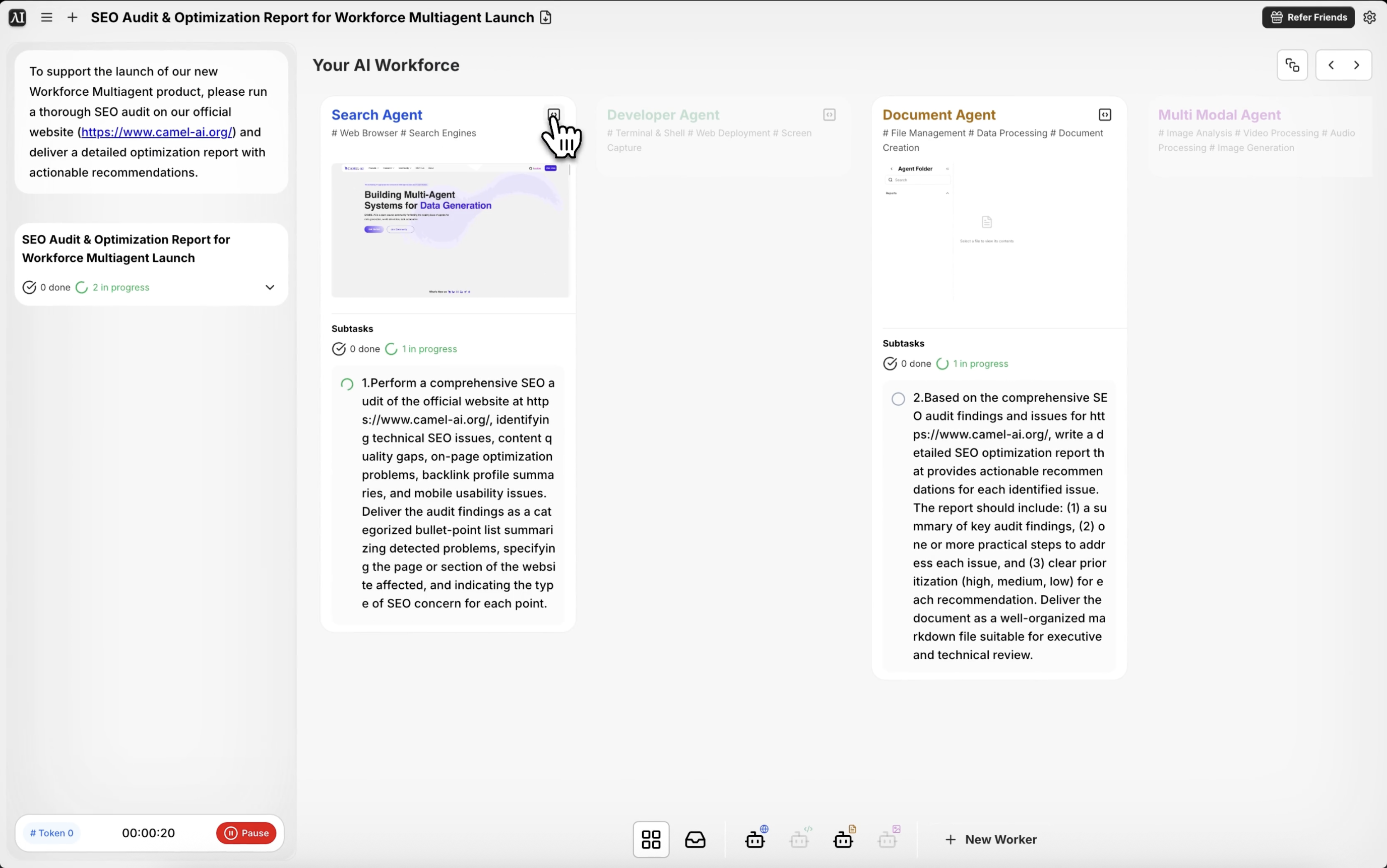
Lancez un audit SEO complet avant le lancement de votre produit
Lancer un nouveau produit sans vérifier votre base SEO revient à ouvrir une boutique sans enseigne. Un audit vous indique ce qui fonctionne, ce qui est cassé et où se trouvent les plus grandes opportunités — avant même de dépenser quoi que ce soit en promotion. Ce workflow utilise Eigent pour exécuter un audit SEO approfondi et automatisé sur un site web en ligne et livrer un rapport structuré avec des recommandations exploitables.
Rédigez le prompt d’audit
Le prompt de ce workflow est direct :
Pour soutenir le lancement de notre nouveau produit Workforce Multiagent, veuillez réaliser un audit SEO complet sur notre site officiel (https://www.camel-ai.org/) et fournir un rapport d’optimisation détaillé avec des recommandations exploitables.
Remplacez-le par votre propre URL et le contexte de votre produit. Plus vous fournissez de contexte — de quoi parle le site, qui est le public cible, quels mots-clés vous cherchez à positionner — plus les recommandations seront précises.
Eigent parcourt le site web
L’agent de navigateur d’Eigent navigue sur le site de manière systématique, en visitant les pages clés pour collecter des données brutes. Il examine les titres de page et les méta-descriptions, la structure des titres (H1, H2, H3), le format des URL, les schémas de maillage interne, les attributs alt des images, les indicateurs de chargement des pages, le rendu mobile et les balises canoniques.
Ce crawl s’exécute sur plusieurs pages en parallèle afin de couvrir efficacement l’ensemble du site.
Analyse technique SEO
Au-delà des éléments on-page, Eigent évalue les signaux techniques que les moteurs de recherche utilisent pour indexer et classer votre site. Cela inclut la vérification des liens cassés, des balises méta manquantes ou dupliquées, des pages bloquées par robots.txt alors qu’elles ne devraient pas l’être, des chaînes de redirection incorrectes et de la présence de données structurées (schema markup).
Analyse des écarts de contenu et de mots-clés
Eigent analyse le contenu existant par rapport aux mots-clés cibles et au public du produit en cours de lancement. Il identifie les pages bien optimisées, les pages qui manquent de couverture de mots-clés critiques et les opportunités où de nouveaux contenus pourraient capter du trafic de recherche pertinent pour le lancement.
Livraison du rapport de recommandations
Le résultat est un rapport d’optimisation structuré, avec des constats classés par priorité — problèmes critiques (éléments qui nuisent activement au classement), améliorations à fort impact (changements offrant un potentiel important) et gains rapides (optimisations à faible effort). Chaque recommandation inclut une explication claire de son importance et de l’action à entreprendre.
Pourquoi c’est important
Les audits SEO manuels prennent des jours et nécessitent une expertise en SEO technique, stratégie de contenu et analyse concurrentielle. Eigent condense cela en un seul workflow qui fournit en quelques minutes un rapport structuré et exploitable. Pour un lancement de produit, cela signifie que vous pouvez identifier et corriger les problèmes les plus critiques avant de commencer à générer du trafic — au lieu de découvrir des problèmes après avoir déjà dépensé votre budget.
Que tester ensuite
Exécutez le même audit sur le site de notre concurrent à [URL] et comparez les résultats.
Générez une liste de 20 titres d’articles de blog ciblant les mots-clés issus de cet audit.
Vérifiez à nouveau les recommandations de l’audit après avoir mis en œuvre les changements la semaine prochaine.
Auditez uniquement les pages d’atterrissage du produit Workforce Multiagent et concentrez-vous sur les signaux SEO liés à la conversion.
Conseils pour de meilleurs résultats
-
Précisez les mots-clés que vous ciblez. Si vous avez une liste de mots-clés pour lesquels vous souhaitez que le site se positionne, incluez-les dans le prompt. Eigent alignera son analyse des écarts de contenu sur ces termes spécifiques.
-
Incluez les URL des concurrents. Ajouter « vérifiez aussi comment notre site se compare à [URL du concurrent] » donne un contexte concurrentiel aux recommandations, et pas seulement une évaluation absolue.
-
Demandez une liste d’actions priorisées. Demander « un top 10 des changements les plus impactants que je devrais faire cette semaine » vous donne un point de départ clair au lieu d’un rapport complet mais potentiellement écrasant.