logo
  • 환경
  • 엔터프라이즈
  • 요금제
DeveloperJun 16, 2026

Long-Horizon Task: GLM-5.1 vs GLM-5.2 on Eigent

EigentEigent
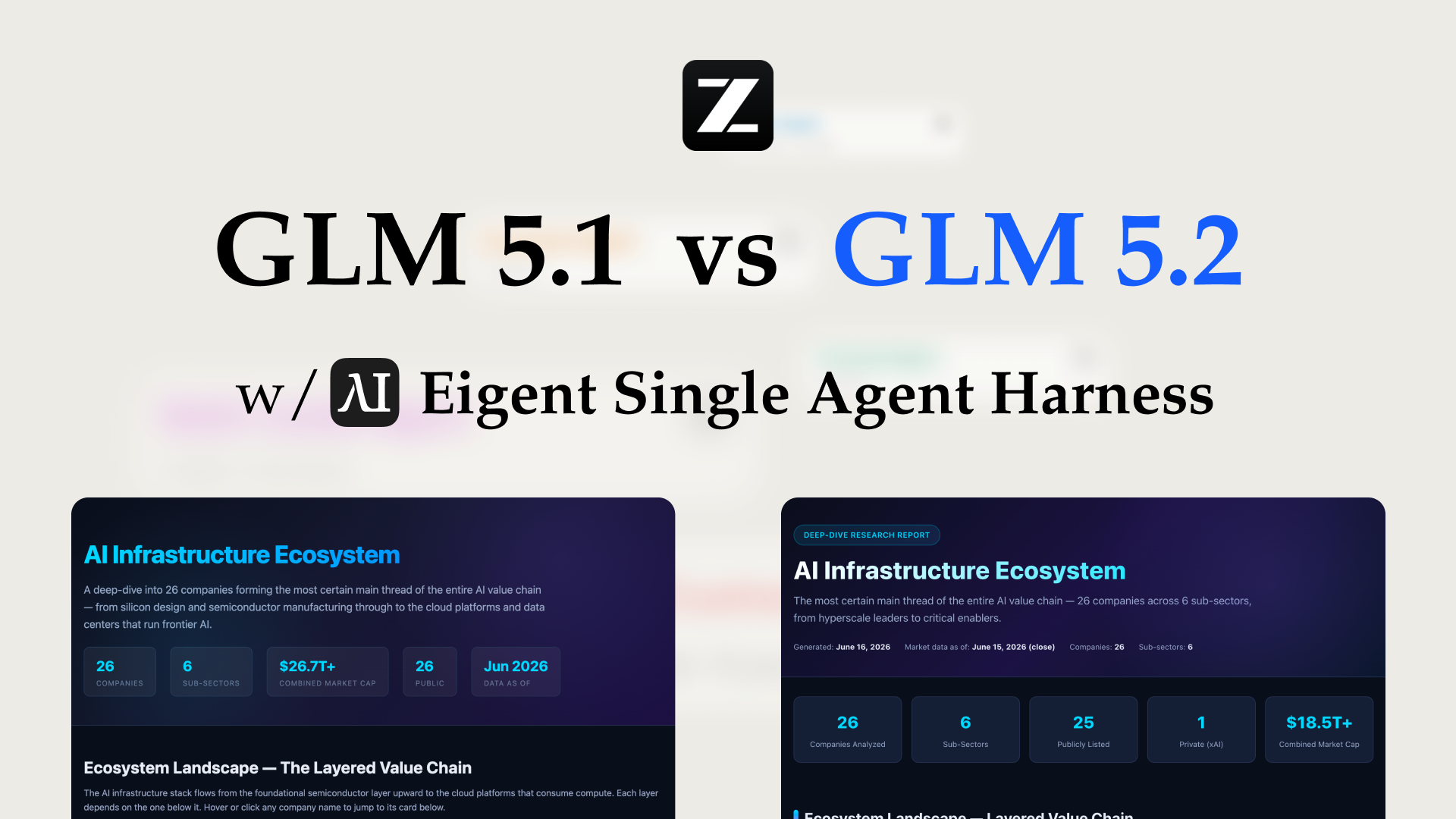
GLM-5.1 vs GLM-5.2 — Long-Horizon AI Infrastructure Research on Eigent's Single-Agent Harness
Automate Everything with
AI Workforce on Desktop
Download Eigent

One Task, Two Models, the Same Agent

The cleanest way to compare two models is to change nothing else. So we did exactly that: same long-horizon task, same agent, same tools. We handed GLM-5.1 and GLM-5.2 the identical brief inside Eigent's single-agent harness and watched how each one planned, researched, verified, and shipped.

The job was a real piece of analyst work, not a toy benchmark:

Research 26 companies across the AI infrastructure stack — from silicon design and semiconductor manufacturing through to the cloud platforms and data centers that run frontier AI — then build an interactive report.

A long-horizon task like this is where models actually separate. It is not one clever answer; it is dozens of small decisions strung together over a long run: how deep to plan, how many sources to trust, when to stop researching, and how much to verify before declaring done.

The Prompt

We sent both runs the same prompt, in single-agent mode:

Do a deep-dive research on 26 companies in the AI infrastructure ecosystem — the most certain main thread of the entire AI value chain. Cover the following 6 sub-sectors (pick representative companies in each, from large-cap leaders down to smaller players):

  • AI Data Center (compute infrastructure / build-out)
  • GPU / AI Chips (training & inference silicon, ASICs, IP)
  • Servers, Networking & Optical Modules (switches, NICs, optical interconnect)
  • Power, Liquid Cooling & Energy Storage (power supply, thermal, energy management)
  • AI Cloud / Compute Platform (hyperscalers, GPU clouds, compute-rental platforms)
  • Supporting Ecosystem (HBM / advanced packaging, foundry, connectors & other critical components)

For each company, research: company name, sub-sector, HQ / country; core products and its specific role in the AI chain; public or private (ticker + exchange if listed; if private, note latest valuation / funding round); market cap or valuation size (for ranking); positioning and moat (1–2 sentences); key customers / competitors.

Rank companies within each sub-sector from largest to smallest, and structure the whole thing top-down: from the full hardware-ecosystem landscape down to each individual company.

Output: First generate a structured ai_infra_data.json with all 26 companies, the 6 sub-sector classifications, a public/private flag, and a cross-company comparison matrix. Then generate a polished, interactive HTML report from that JSON — ecosystem landscape diagram, sector sections, company cards, public-vs-private color coding, a market-cap ranking chart, and a sortable/filterable comparison table. Verify the research data for accuracy first (listing status, tickers, valuations — latest figures, cited sources), then generate the report.

1Prepare to Execute — GLM-5.2 Plans Deeper

The first divergence showed up before either model touched the web: in the plan.

GLM-5.1 broke the work into 4 steps. GLM-5.2 expanded the same brief into 6 steps — and, tellingly, made "verify accuracy" its own dedicated task rather than something to do in passing. That is how a careful analyst scopes the job: research, then prove the research, then build.

Same instructions. Different judgment about how much rigor the task deserves.

2The Research — Twice the Sources

The plans turned into very different research runs.

  • GLM-5.1: ~40 sources
  • GLM-5.2: ~82 sources — roughly 2× the research

And it was not just more pages — it was better-distributed pages. Where GLM-5.1 leaned heavily on a single data site, GLM-5.2 cross-checked each figure across financial news, company filings, and private-market databases: Reuters, Bloomberg, Crunchbase, TechCrunch, and more.

One source isn't enough. For valuations, tickers, and listing status, GLM-5.2 treated a single number as a hypothesis to confirm — not a fact to copy.

GLM-5.2 didn't just answer faster. It dug deeper, pulling from twice as many pages to verify every figure.

3Verify Before Finish

Because GLM-5.2 had carved out verification as its own step, it actually did it — re-checking listing status, tickers, and valuations against the latest figures before committing them to the report. The result is a report that proves its work instead of asserting it.

4The Result — Deeper Data, Real Citations

Same task. Two very different deliverables.

GLM-5.2 produced:

  • A richer data schema with dedicated moat analysis, funding details, and a full source list — every claim traceable back to where it came from.
  • A final report that was nearly 2× richer than GLM-5.1's in both data and structure.
  • Output shipped as a fully deployable, interactive site — not just a static HTML page: ecosystem landscape diagram, sector sections, public-vs-private color coding, a market-cap ranking chart, and a sortable/filterable comparison table.

GLM-5.1 delivered a solid, correct report. GLM-5.2 delivered one you could hand to an investment committee.

5Why This Matters

On a short task, two capable models look about the same. On a long-horizon task, the differences compound. Every extra source GLM-5.2 chose to read, every figure it chose to double-check, and the decision to make verification a first-class step all stacked up into a measurably better result.

The harness was identical. The tools were identical. The only variable was the model — and that is exactly what makes this a fair read on how GLM-5.2 reasons over a long run:

More sources. Sharper judgment. A report that proves its work.

6Run It Yourself

Eigent lets you swap the model behind the same single-agent harness, so you can run this exact comparison on your own task:

  1. Go to Settings → Models and select or add the model you want to test (GLM-5.1, GLM-5.2, or any function-calling model).
  2. Switch the task to single-agent mode.
  3. Paste the deep-research prompt above (or your own long-horizon brief).
  4. Send it once per model, then compare the plans, the source counts, and the final reports side by side.

7What to Try Next

Re-run the same brief but require at least 3 independent sources per valuation, and flag any company where the sources disagree.

Expand the universe from 26 to 50 companies and add a "supply-chain dependency" column to the comparison matrix.

Generate a one-page executive summary of the final report as a PDF, plus a slide deck of the market-cap ranking chart.

Run GLM-5.2 against another model on the same task and produce a diff report: where they agreed, where they disagreed, and which had better sourcing.

8Tips for Better Results

  • Make verification explicit. Asking the model to "verify accuracy first, then build" measurably changes behavior — GLM-5.2 turned that line into its own planning step.
  • Demand citations in the schema. Requiring a sources field per company forces traceable research instead of confident guesses.
  • Separate data from presentation. Generating ai_infra_data.json before the HTML keeps the report regenerable and the facts auditable.
  • Use single-agent mode for long-horizon reasoning. It keeps the full task context in one model's hands, which is exactly what you want when comparing how a model plans and self-corrects over a long run.

Other use cases

Build 10 Chinese New Year HTML5 Games with Eigent

Build 10 Chinese New Year HTML5 Games with Eigent

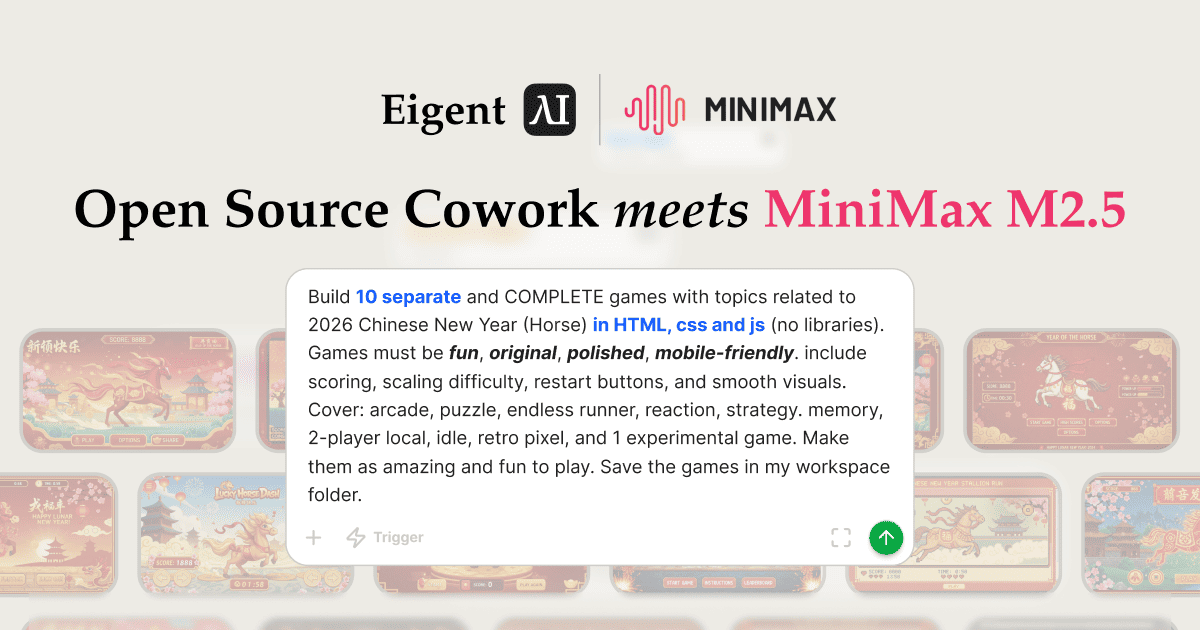
Build 10 separate and COMPLETE games with topics related to 2026 Chinese New Year (Horse) in HTML, CSS and JS (no libraries). Games must be fun, original, polished, mobile-friendly. Include scoring, scaling difficulty, restart buttons, and smooth visuals. Cover: arcade, puzzle, endless runner, reaction, strategy, memory, 2-player local, idle, retro pixel, and 1 experimental game.

Build a 3D Snow Bros Platformer with Gemini 3.1 Pro

Build a 3D Snow Bros Platformer with Gemini 3.1 Pro

Create a modern 3D side-scrolling platformer inspired by Mario, combined with Snow Bros mechanics. The player can shoot snow projectiles to freeze monsters into snowballs, then kick them to chain into other enemies. Include a scoring system, lives display, scaling difficulty, and a restart function with rich 3D layered environments.

Configure Gemini & Automate Salesforce Deals

Configure Gemini & Automate Salesforce Deals

I need to update the salesforce.com - 200 Widgets deal. Give me the contact name and phone number. Back to the Opportunities page, edit the Next Step as 'book a meeting with + the contact name and phone number.'

Automate everything with AI workforce on desktop
Download Eigent

오늘 Eigent를 사용해보세요

오픈 소스 데스크톱 앱을 다운로드하세요. 여러분의 AI 워크포스가 여러분의 기기에서 실행됩니다.

Eigent 다운로드
Eigent

AI 워크포스 자동화에 대한 최신 소식, 튜토리얼, 출시 정보를 받아보세요.

제품Eigent환경요금엔터프라이즈
둘러보기솔루션활용 사례스킬플러그인블로그
개발자문서GitHubCAMEL-AI오픈소스 펀드파트너
다운로드오픈 소스용
회사회사 소개브랜드채용이용약관개인정보처리방침보안 및 신뢰쿠키 정책환불 및 체험 정책

모든 권리 보유 © 2026 EIGENT UK LTD

Eigent 1.0 새 버전 출시!download