
Self-hosting
Run Eigent with your own backend, model providers, and local Spaces.
Self-host Eigent when you need control over model providers, credentials, project files, or the infrastructure that runs your agents. A self-hosted installation uses the open-source Eigent application and lets you connect cloud APIs, OpenAI-compatible endpoints, or local inference servers.
This page describes the recommended setup path. Exact deployment requirements can change between releases, so use the repository files and release notes as the source of truth for version-specific values.
Before you begin
Prepare the following:
- A supported desktop operating system or Linux development environment
- Git
- Node.js
18through22 - The Python version required by the repository backend
- Enough disk space for dependencies, generated files, and optional local models
- Credentials for at least one cloud provider, or a running local model server
Local model requirements depend on the model and runtime. Large models can require substantial memory or GPU capacity.
Choose a deployment model
Eigent supports three common arrangements:
| Arrangement | Model execution | Best for |
|---|---|---|
| Managed application | Eigent Cloud | Fast evaluation with minimal setup |
| Self-hosted with BYOK | External provider APIs | Infrastructure control with hosted model quality |
| Fully local | Ollama, vLLM, SGLang, LM Studio, or LLaMA.cpp | Private environments and local experimentation |
You can configure more than one provider and change the preferred model later.
Set up the repository
Clone the Eigent repository:
git clone https://github.com/eigent-ai/eigent.git
cd eigent
Install the frontend dependencies:
npm installReview
.env.development,backend/README.md, and the rootREADME.mdfor the current backend and environment configuration.Start the development application:
npm run devIn Eigent, open Agents > Models and configure a model provider.
The first development start can take longer because Eigent prepares frontend and backend dependencies.
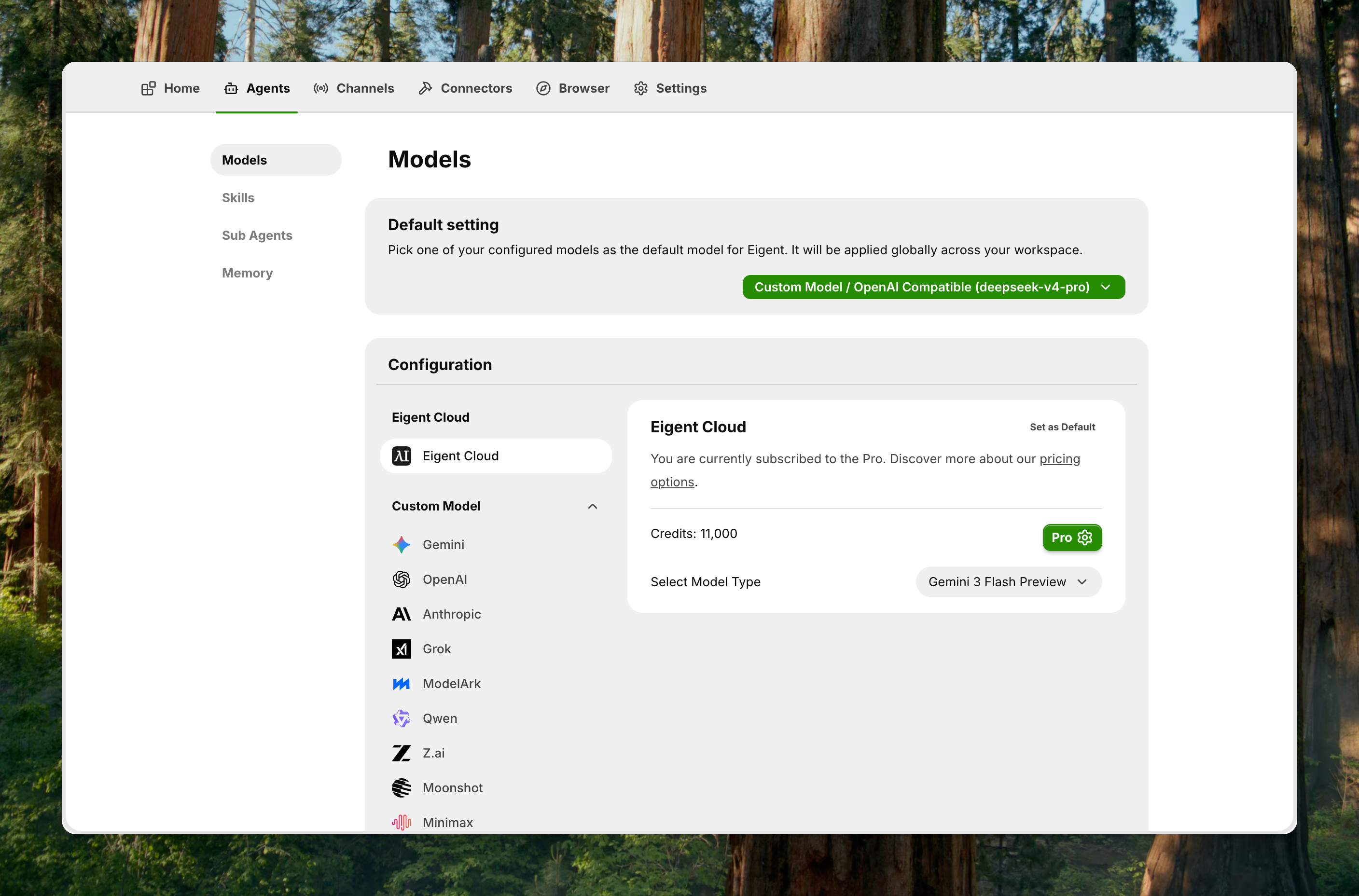
Configure a model
For the fastest self-hosted setup, connect an existing provider:
- In Eigent, open Agents > Models.
- Expand Bring Your Own Key.
- Select a provider.
- Enter the API key, endpoint, and model name required by that provider.
- Select Validate or Save.
- Enable the provider and mark it as preferred when you want it to be the default.
To keep inference local, start one of the supported runtimes and follow Local models.
Configure tools and browser access
A model can reason about a task, but tools let it act.
- Add your own local or remote server from Custom MCP servers.
- Configure a CDP browser from Browser connections.
- Create a Space from a local folder when agents need direct access to project files.
Build a distributable application
Use the build script for the target platform:
npm run build
Platform-specific scripts include:
npm run build:mac
npm run build:win
npm run build:linux
Review the Electron signing, packaging, and backend dependency requirements before distributing a build to other users.
Update a self-hosted installation
- Commit or back up local configuration changes.
- Pull the target release or branch.
- Review release notes and environment changes.
- Reinstall dependencies when lockfiles changed.
- Run the relevant tests and build command.
- Start Eigent and validate models, connectors, browser sessions, and existing Spaces.
Troubleshooting
The application starts without a model
Open Agents > Models and configure at least one cloud, BYOK, or local provider. Eigent blocks new tasks when no valid model is available.
A local model cannot be reached
Confirm that the runtime is running, the endpoint includes the expected /v1 path, and the port is accessible from the Eigent process.
MCP tools fail during startup
Review the MCP command, arguments, environment variables, and executable path. Run the server independently to confirm that it starts before adding it to Eigent.
Browser connection fails
Confirm that Chrome or Chromium was started with remote debugging and that the configured port exposes /json/version.