
Best Open Source AI Coding Agents
Seven genuinely open tools and model components ranked by use case, with clear warnings on security, maintenance, hardware, and hidden operating cost.
 Douglas Lai
The best open source AI coding agents serve different jobs. Choose Eigent for multi-agent work that extends beyond code, Aider for terminal and Git pair programming, OpenHands for asynchronous software-agent infrastructure, Cline for IDE approvals, and SWE-agent for reproducible issue-to-patch research. Continue is now a legacy choice because its official repository is read-only, while Kimi K2 is an open-weight model that needs an agent harness—not a coding agent by itself.
Quick picks
| Use case | Pick | License/status | Why it earns the place |
|---|---|---|---|
| Multi-agent work beyond code | Eigent | Apache-2.0 | Coordinates coding with browser, terminal, research, and documents |
| Terminal and Git | Aider | Apache-2.0 | Lean repository map and automatic Git workflow |
| Async agent server | OpenHands core | MIT | Multiple execution backends and automation support |
| IDE agent with approvals | Cline | Apache-2.0 | Plan/Act modes, diffs, checkpoints, and command approvals |
| Research issue-to-patch | SWE-agent | MIT | Reproducible research lineage and BYO model |
| Legacy customizable IDE stack | Continue | Apache-2.0, read-only | Useful codebase, but maintenance status changed |
| Model beneath an agent | Kimi K2 | Modified MIT weights/code | Privately deployable open-weight option with heavy infrastructure needs |
No single product wins every row. Aider is more focused than Eigent for direct pair programming; Cline has the clearer IDE approval experience; OpenHands is closer to a self-hosted asynchronous software engineer.
What counts as an open source AI coding agent?
A public repository is not enough. The functional application needs source code and a license that permits use, modification, and redistribution. A free tier does not make proprietary software open source.
Models need a second distinction. The Open Source Initiative's Open Source AI Definition includes access to information and code needed to modify an AI system, not only downloadable weights (OSI definition). “Open-weight” is therefore the safer term for a model release when training-data information and all derivation components are not available.
This guide evaluates applications and models on different layers:
- Agent application: user interface, tool loop, permissions, repository handling, and execution.
- Model: the reasoning and generation engine underneath the application.
- Runtime: hosted API, local model server, container, VM, or remote worker.
- Control plane: scheduling, approvals, logs, identity, and background work.
Buying or installing one layer does not solve the others.
Comparison table
| Tool | Interface | Self-host/local path | BYO model | Approval/sandbox posture | Best fit | Main risk |
|---|---|---|---|---|---|---|
| Eigent | Desktop workspace | Yes | Yes | Operator-designed scopes and reviews | Multi-agent development plus adjacent work | Generalist, not IDE-native autocomplete |
| Aider | Terminal | Yes | Broad providers | Direct developer supervision and Git commits | Small, controlled edit loops | Less suitable for background orchestration |
| OpenHands | Web/CLI/server | Docker, VM, local, cloud | Yes | Sandbox depends on backend | Async issue work and automations | Unsandboxed mode can expose host files |
| Cline | IDE/CLI | Local application | Yes | Per-edit/command approval; auto-approve optional | Human-in-the-loop IDE work | API spend and risky auto-approval |
| SWE-agent | CLI/research harness | Yes | Yes | Research/operator configured | Benchmarks and issue-to-patch experiments | Not a polished daily IDE |
| Continue | IDE/CLI | Yes | Yes | Configuration dependent | Existing teams and forks | Official repo is read-only |
| Kimi K2 | Model weights/API | Heavy self-host path | N/A | Harness dependent | Model underneath an agent | 1T total parameters and Modified MIT terms |
Sources and exact license/status details are linked in each review below.
1. Eigent: best for multi-agent development plus adjacent work
Eigent is an Apache-2.0 multi-agent workspace. Its repository describes a source quickstart that connects to Eigent cloud and a separate Local Deployment path for a standalone experience (Eigent repository). That distinction matters: running the desktop application locally does not by itself guarantee that model context stays local.
Eigent earns its place when the task crosses tool boundaries. A coding agent can work with browser research, terminal commands, documents, and other specialists inside one workspace. That is useful for workflows such as issue triage, implementation, test execution, release-note drafting, and stakeholder documentation.
The gap is focus. Eigent is not an IDE autocomplete engine or a purpose-built remote software engineer. For a fast supervised edit, Aider may be simpler. For an IDE-native Plan/Act loop, Cline may be clearer. For a background issue worker, OpenHands may fit better.
Best for: teams that want an inspectable orchestration layer around development work, especially when the result is more than a code diff.
2. Aider: best Git-native terminal pair programmer
Aider is Apache-2.0, builds a map of the repository, supports more than 100 programming languages, and records its edits in Git (Aider repository). The operational footprint is small: a developer stays close to the diff and can use the model provider that fits the task.
That directness is also the boundary. Aider is primarily a terminal pair programmer, not a remote multi-agent operations system. It is strongest when a human is present to scope, review, and correct each change.
Best for: developers who want an open, model-flexible coding loop without adding a new orchestration platform.
3. OpenHands: best open asynchronous software-agent platform
OpenHands' core is MIT-licensed and supports local, Docker, VM, and cloud execution backends as well as scheduled or event-driven automation (OpenHands repository). It is the closest choice here to an open platform for delegated repository work.
Security needs to be a first-class setup task. The official quickstart warns that an unsandboxed local agent receives full filesystem access, while Docker can constrain access to mounted project directories (OpenHands repository). A fast install with unrestricted host access is not a responsible production configuration.
Best for: technical teams willing to operate and harden an asynchronous coding-agent service.
4. Cline: best IDE agent with explicit approvals
Cline is an Apache-2.0 agent for IDE and CLI use. It can read a project, coordinate edits, execute terminal commands, monitor errors, and separate planning from action while requesting approval for edits and commands (Cline repository).
The approval loop is a practical control for unfamiliar repositories. Auto-approve can speed up trusted work, but it also removes the exact friction that protects against broad file edits, unsafe commands, and prompt-injected instructions.
Best for: developers who want an open agent inside their existing editor and prefer to see each consequential action.
5. SWE-agent: best for reproducible issue-to-patch research
SWE-agent is an MIT-licensed research system that gives a language model a GitHub issue and tools with which to attempt a patch (SWE-agent repository). Its benchmark lineage and explicit task framing make it useful for evaluations, academic work, and building a repeatable issue-solving harness.
It is not a polished all-day editor. The repository also mentions offensive-security applications; those are outside this guide. Use it on repositories you own or are authorized to test, with a defensive development scope.
Best for: researchers and engineering teams building controlled, comparable issue-to-patch experiments.
6. Continue: a legacy option with a maintenance warning
Continue has an Apache-2.0 codebase and historically shipped VS Code, JetBrains, and CLI workflows. Its official repository now says it is read-only and no longer actively maintained, while pointing users toward its final CLI path (Continue repository).
That does not erase its value as a reference or fork base. It does mean new teams should not rank it alongside actively maintained choices without a maintenance plan.
Best for: existing deployments, internal forks, or teams specifically prepared to maintain the code.
7. Kimi K2: a model, not a coding-agent application
Moonshot publishes Kimi K2 code and weights under a Modified MIT license. The model card lists one trillion total parameters and deployment through runtimes such as vLLM and SGLang (Kimi K2 model card).
Kimi K2 still needs Eigent, OpenHands, Aider, Cline, or another harness to read repositories, call tools, edit files, and manage approvals. Its scale also makes “run it locally” materially different from a laptop-friendly model. Review the license and infrastructure plan before describing it as a free local replacement for a hosted coding model.
Best for: teams with serious inference infrastructure that want an open-weight model beneath a controlled agent stack.
Security: open agents can execute the wrong thing transparently
Source access helps an audit, but it does not make runtime behavior safe. Coding agents read untrusted repositories and documentation, execute commands, install packages, and may access credentials. Indirect prompt injection and confused-deputy behavior are especially dangerous when model text can trigger tools.
Use a baseline control set:
- Run the agent as a non-admin user in a container or VM.
- Mount only the target repository; deny home-directory and credential-store access.
- Start with no production secrets and restricted network egress.
- Require approval for commands, dependency changes, and external messages.
- Allowlist build and test commands for routine tasks.
- Keep immutable tool-call, diff, and test logs.
- Treat repository text, issues, and web pages as untrusted data.
- Require a human merge and deployment decision.
OpenHands' explicit unsandboxed-filesystem warning is a useful reminder that “local” can increase host risk if permissions are broad (OpenHands repository).
The real cost of a free AI coding agent
Open-source application code removes a license fee, not the whole bill. A hosted model adds token charges. A local model adds GPU purchase or rental, power, capacity planning, and maintenance. Every path adds security review, upgrades, evaluation, observability, and developer review time.
Compare tools on cost per accepted outcome:
- model or GPU cost per merged change;
- reviewer minutes per accepted diff;
- failed attempts and rollback rate;
- escaped defects;
- time lost to setup, queues, or rate limits;
- operator effort for upgrades and security.
A “free” tool that doubles review time can cost more than a managed seat. A paid tool that traps critical instructions and indexes can be more expensive to leave.
How to choose and test
Build a private evaluation set with six tasks: bug fix, multi-file refactor, test creation, dependency update, code explanation, and an instruction that should be refused because it touches out-of-scope files. Use the same model where possible, and record every tool version and permission.
Choose Eigent when the workflow crosses code, research, browser, terminal, and documents. Choose Aider for the shortest Git loop, Cline for visible approvals, OpenHands for background agent infrastructure, and SWE-agent for reproducibility.
For deeper setup guidance, read /blog/self-hosted-ai-coding-agent. For managed-product comparisons, see /blog/devin-alternative, /blog/windsurf-alternative, and /blog/replit-alternative.
Build the workflow around the tool
The best open source AI coding agent is the one your team can constrain, evaluate, and replace. Eigent can coordinate a transparent workflow for understanding large codebases while Aider, Cline, or OpenHands handles the most focused coding loop. Download Eigent and start with a synthetic repository before widening access.
Recent Posts
Meta Muse: The Personal AI Agent That Books, Buys, and Negotiates
Meta Muse is a personal AI agent that books travel, buys things, and negotiates bills from a chat. Here's what it does, pricing, security, and how it compares.
 Eigent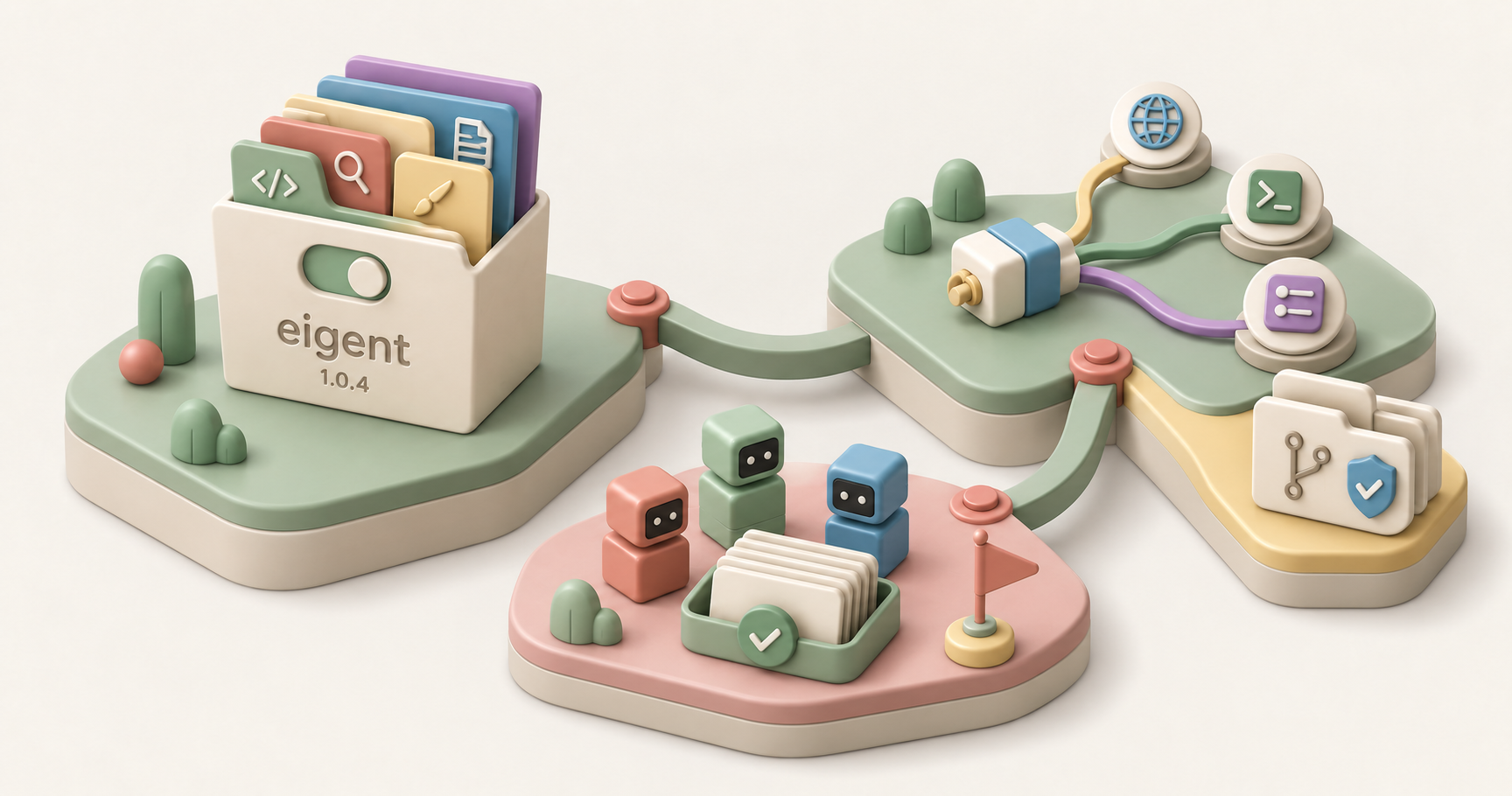
Eigent Release Notes v1.0.4: Skills & Connectors Dashboards, Durable Multi-Turn Runs
Eigent v1.0.4 rebuilds Skills and Connectors as management dashboards and strengthens multi-turn agent work, workspace checkpoints, and connector states.
Douglas Lai
Claude Fable 5.1 and Mythos 5.1: What's New, Explained
Claude Fable 5.1 and Mythos 5.1 explained: the same model in two safeguard tiers, with new benchmarks, roughly 25 to 45 percent lower cost, and access details.
Eigent


