
Eigent vs Claude Cowork: The Definitive Open-Source AI Cowork Comparison (2026)
Multi-agent open-source desktop vs proprietary single-agent cloud — which AI coworker fits your workflow?
 Douglas Lai
The AI coworker space exploded in early 2026. Instead of copying and pasting context into a chatbot, tools like Claude Cowork and Eigent let you hand off entire workflows — file cleanup, report generation, web research, code execution — and get finished results back. But these two platforms make fundamentally different bets on openness, architecture, and who they serve.
This Eigent vs Claude Cowork comparison breaks down every major dimension so you can pick the right AI cowork desktop for your team. Whether you need a polished proprietary agent or a fully customizable open-source AI cowork platform, this guide has you covered.
Why AI Cowork Tools Matter in 2026
The new generation of AI coworkers goes far beyond chatbots. They plan work, operate on your files and apps, coordinate subtasks, and hand back finished outputs instead of text snippets. Organizations adopting these tools report significant productivity gains across knowledge work, engineering, and operations.
Both Claude Cowork and Eigent promise this shift, but they take very different paths to get there. Understanding those differences is critical before you commit your team's workflows to either platform.
What Is Claude Cowork?
Claude Cowork is a desktop AI agent built on Anthropic's Claude models. You point it at a folder and a goal — "tidy my Downloads," "turn these notes into a report" — and it plans and executes multi-step tasks for you. It reads and edits files, creates new documents, and keeps you updated with live progress as it works through its plan.[1][2]
Cowork grew out of the Claude Code agent architecture and is designed as a friendlier layer for non-developers. It focuses on file management, document processing, and basic computer tasks rather than terminal-heavy workflows. It integrates with connectors like Asana and Notion, and can work together with Claude-in-Chrome for browser-based tasks.[3][4]
Claude Cowork Strengths
- Polished UX designed for non-technical knowledge workers
- Deep integration with Anthropic's Claude model ecosystem
- Live progress tracking with human-in-the-loop controls
- Connectors for Asana, Notion, and browser-based tasks
What Is Eigent?
Eigent is an open-source AI cowork desktop built on the CAMEL-AI multi-agent framework. Rather than relying on a single assistant, Eigent spins up specialized agents — developer, browser/search, document, multimodal — that work in parallel under an orchestrator to complete complex workflows.[5][6][7]
It runs as a desktop-native app with full local deployment support and can be configured to keep all data and model inference on your own machine. Eigent is 100% open source (Apache 2.0) with over 10k GitHub stars, and supports multiple LLM providers including local Ollama models, Gemini Pro, and others.[6][8][5]
Eigent Strengths
- Multi-agent workforce architecture for true parallel execution
- 100% open source with Apache 2.0 license
- Full local deployment — keep all data on your infrastructure
- Model-agnostic — use Ollama, Gemini Pro, MiniMax, or any provider
- 200+ MCP tools with extensible Skills system
- Enterprise features including SSO and RBAC
Architecture: Single-Agent vs Multi-Agent
This is the most fundamental difference between the two platforms, and it shapes everything else.
Claude Cowork: Single-Agent First
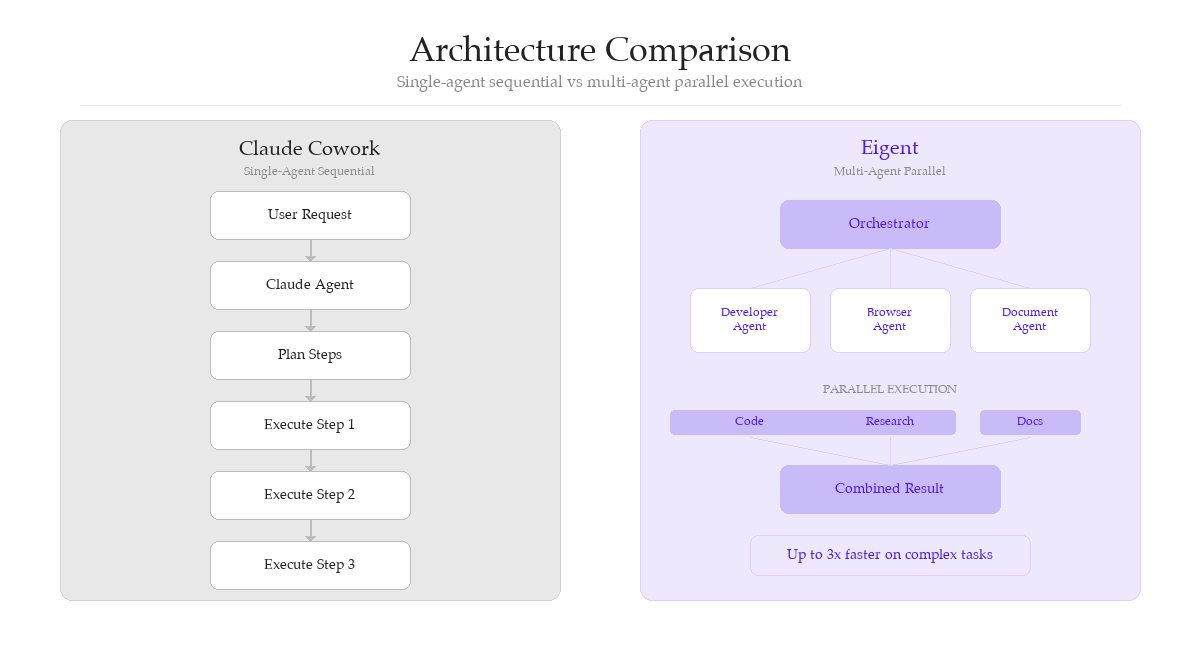
Claude Cowork is single-agent first. You describe an outcome, it generates a plan, and it executes that plan step by step. It may queue multiple parallel subtasks, but everything is fundamentally driven by a single Claude agent per job. This makes mental models simple — Cowork feels like one very capable teammate operating in the background.[2][3]
Eigent: Multi-Agent Native
Eigent is multi-agent native. Its core architecture is a coordinated team of agents, each with a specialized role (code, browser, documents, multimodal), collaborating under an orchestrator. In practice, this means Eigent can split a workflow — one agent scraping the web, another writing code, another editing documents — and run them in true parallel.[5][6]
This pays off significantly for long-horizon or high-volume tasks where sequential execution creates bottlenecks. The task monitor UI makes it easy to see which agents are doing what at any moment.[8]
Openness and Deployment: Closed Cloud vs Open Local
For many teams, especially those with compliance requirements, the deployment model is the deciding factor.
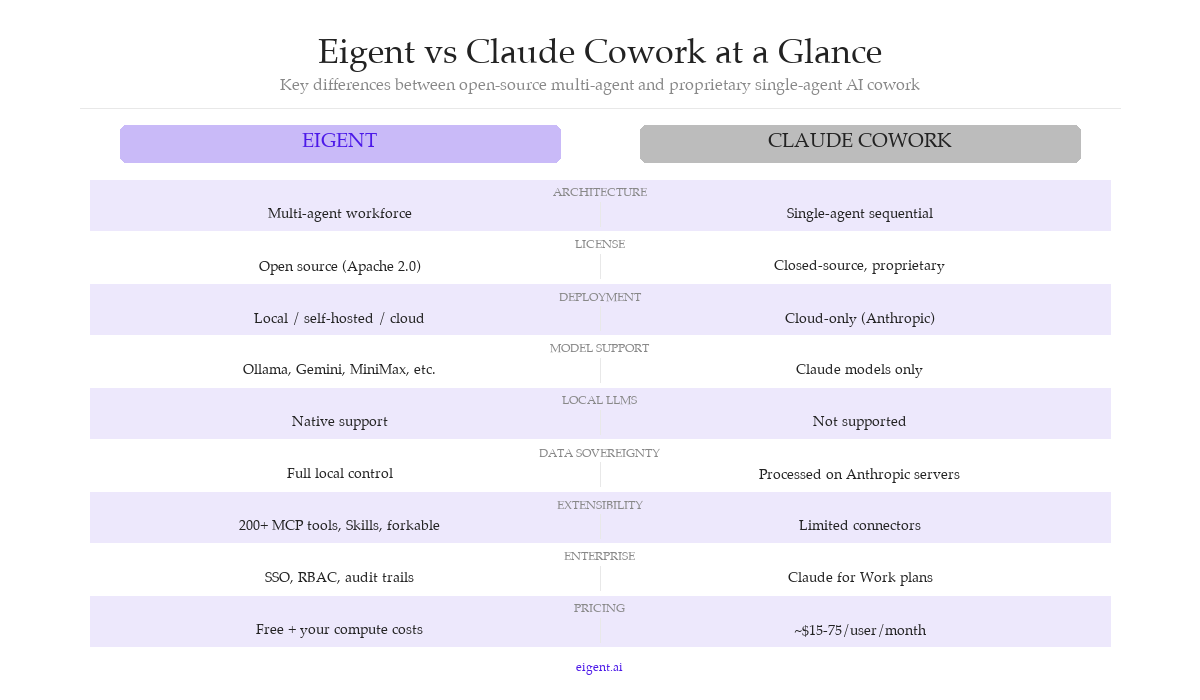
| Dimension | Claude Cowork | Eigent |
|---|---|---|
| License | Closed-source, proprietary | 100% open source (Apache 2.0) |
| Self-hosting | Not supported | Full self-hosting supported |
| Local-only operation | No — requires Anthropic cloud | Yes — fully local possible |
| Auditable / forkable | No | Yes |
| Data sovereignty | Data processed on Anthropic servers | All data stays on your machine |
Claude Cowork is fully proprietary and tied to Anthropic's cloud. You cannot self-host it, audit the codebase, or fork it, and there is no support for running the core agent with local LLMs — every task routes through Anthropic's servers.[9]
Eigent can be run entirely locally, with all data and model calls kept on your own desktop or private infrastructure. That makes it the go-to choice for teams with strict compliance requirements or those who want to extend or audit the platform. Enterprise options layer on SSO and RBAC without giving up the open core.[5][6]
Model and Tool Flexibility
Claude Cowork: Locked to Claude
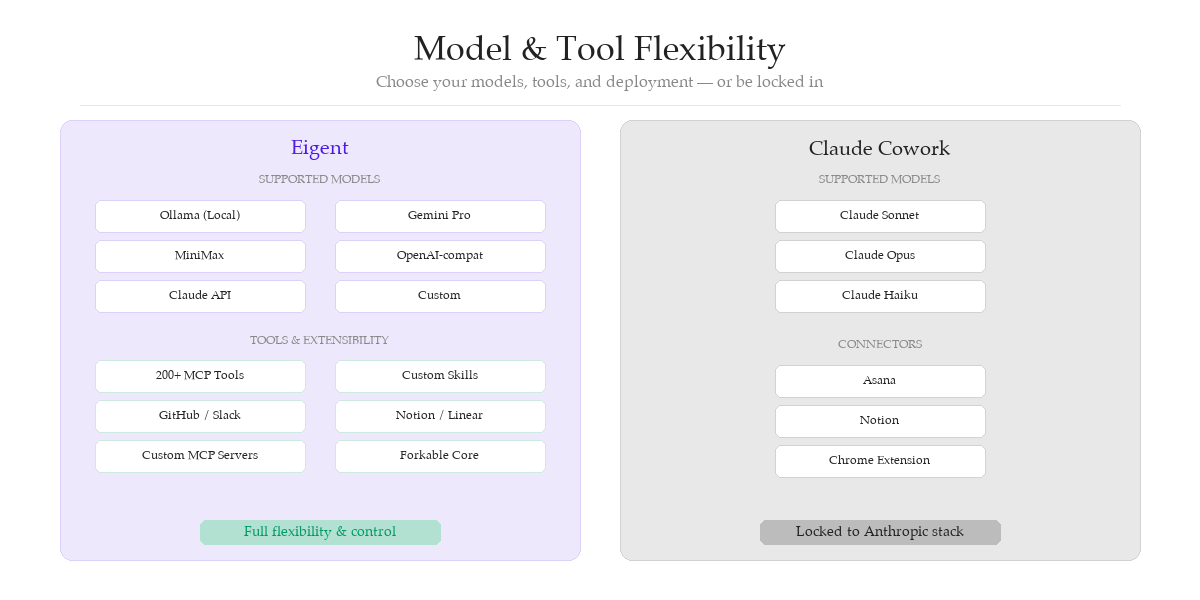
Claude Cowork is tightly bound to Claude models. Its strength is how deeply it integrates Anthropic's reasoning and computer-use capabilities into a polished end-user experience. You don't choose models or backends — the assumption is that Anthropic's stack is what you want.[3][4]
Eigent: Model-Agnostic and Extensible
Eigent is model-agnostic: it supports local LLMs via Ollama, as well as remote providers like Gemini Pro and MiniMax. On the tooling side, Eigent exposes a modular Skills system and deep integration with the Model Context Protocol (MCP), so you can wire in tools like Slack, Notion, GitHub, and custom MCP servers.[6][8][5]
| Dimension | Claude Cowork | Eigent |
|---|---|---|
| Model choice | Fixed to Claude family | Multiple: Ollama, Gemini Pro, MiniMax, others |
| Local LLM support | None | Native support via Ollama etc. |
| Tooling / plugins | Connectors (Asana, Notion) | 200+ MCP tools, Skills system, custom servers |
| Extensibility | Limited to Anthropic ecosystem | Fully customizable and forkable |
Agents and Automation Depth
What Claude Cowork Does Best
Claude Cowork excels at scoped, folder-centric workflows: cleaning and renaming messy files, extracting data from images into spreadsheets, drafting reports from scattered notes, and similar knowledge-worker tasks. It turns a folder into a context window, plans the steps needed, and executes them with live feedback — dramatically reducing context-pasting compared with a normal chat.[4][3][2]
What Eigent Does Best
Eigent leans into more complex, multi-step workloads where different skills need to run in parallel. For example, browsing the web for research while another agent writes and tests code and a third processes PDFs. Reviews highlight that Eigent can split tasks, fire up the right specialized agents, and handle workflows that typically break simpler, single-agent tools.[8][6][5]
Ecosystem and Community
Claude Cowork benefits from Anthropic's broader ecosystem around Claude for Work: enterprise plans, collaboration via Projects, Artifacts for side-by-side code and content, and a growing body of best-practice content for teams. For organizations already standardizing on Claude, Cowork slots naturally into that stack.[10][11][3]
Eigent rides the open-source wave: it has amassed over 10k GitHub stars, with active documentation and tutorials from third parties showing how to run it on Linux, integrate new models, and adopt it inside enterprises. Independent reviews consistently position it as the leading open-source AI cowork platform for desktop and multi-agent use cases.[8][5][6]
Pricing and Total Cost of Ownership
| Factor | Claude Cowork | Eigent |
|---|---|---|
| Base cost | Paid subscription via Anthropic | Free and open source |
| Estimated per-user cost | ~$15–75/month depending on usage | Your own compute + any API costs you choose |
| Self-host option | No | Yes |
| Cost at scale | Scales linearly with users and tasks | Marginal cost trends toward hardware amortization |
Claude Cowork routes all usage through Anthropic's API, and analyses estimate that at scale (thousands of agent tasks per month), usage often lands in the $15–75 USD per active user per month band, depending on intensity and model tier.[4]
Eigent's core is free; you pay for your own compute and any external model/API costs you choose. Third-party comparisons consistently call Eigent the cost winner for high-volume enterprise use, particularly when teams lean on local LLMs where marginal inference cost trends toward hardware amortization rather than per-token fees.[5][8]
Which AI Cowork Tool Fits Your Team?
Choose Claude Cowork if:
- You are an individual or small team already committed to Claude
- You want a polished "just works" desktop agent with minimal setup
- You are comfortable with proprietary, cloud-based infrastructure
- Your tasks are mainly folder-centric knowledge work (files, reports, cleanup)
Choose Eigent if:
- You need strict data control and local-first deployment
- You want multi-agent parallel workflows for complex tasks
- You plan to use multiple LLM providers or local models
- You need enterprise features like SSO, RBAC, and auditability
- You value open source and want to extend, fork, or customize the platform
The Bottom Line
Claude Cowork and Eigent represent two distinct visions for the future of AI coworkers. Claude Cowork bets on a polished, vertically integrated experience tied to Anthropic's models. Eigent bets on openness, multi-agent orchestration, and giving teams full control over their AI workforce.
For teams that care about open-source AI cowork, data sovereignty, and the flexibility to customize their multi-agent AI platform, Eigent is the clear choice. For individuals who want the simplest path to a capable AI desktop assistant within Anthropic's ecosystem, Claude Cowork delivers.
Ready to try Eigent? Free to download, fully open-source, and running in under 10 minutes. Get started at eigent.ai
Frequently Asked Questions
Is Eigent really free to use?
Yes. Eigent is 100% open source under the Apache 2.0 license. Your only costs are the compute infrastructure (local machine or cloud servers) and any external API keys you choose to connect (OpenAI, Gemini, etc.). You can also run fully local models via Ollama at no API cost.
Can Claude Cowork run offline or on-premises?
No. Claude Cowork is a cloud-based service that requires Anthropic's servers for all inference and agent execution. There is no self-hosted or offline option available.
Does Eigent support Claude models?
Yes. Eigent is model-agnostic and supports Claude models via API key, alongside other providers like Gemini Pro, OpenAI-compatible endpoints, local Ollama models, and more. You are not locked into any single provider.
Which tool is better for enterprise compliance?
Eigent's fully local deployment, Apache 2.0 license, SSO, and RBAC features make it the stronger choice for enterprises with strict data governance and compliance requirements. All data and model inference can be kept within your own infrastructure.
Can I switch from Claude Cowork to Eigent?
Yes. Since Eigent works with standard files and integrates via MCP tools, migrating workflows is straightforward. Eigent also supports Claude models via API, so you can keep using the same underlying AI capabilities in an open-source framework.
Sources
- OpenClaw vs Eigent vs Claude Cowork: The Best Open Source AI Cowork Platform
- Claude Cowork | AI Coworker for Task Automation & Productivity
- Claude Co-Work Explained: Anthropic's AI Collaboration Tool
- Anthropic's Claude Cowork Is an AI Agent That Actually Works
- Eigent: Exploring the Top Open Source AI Cowork Desktop Tool
- Multi-Agent Cowork for Complex Tasks
- Eigent Open Source Cowork: the open source cowork desktop
- Eigent AI: The Best Open Source Cowork Alternative
- OpenWork vs Claude Co-work: The Free AI Agent Showdown
- Anthropic adds collaboration features to Claude for customers
- Collaborate with Claude on Projects
Recent Posts
Periodic Neon: The Lab-Trained AI That Beats Frontier Models at Science
Periodic Neon is a 1T-parameter AI trained on physical lab data that beats GPT-6 Astra at diffraction analysis. Here is what it does and why it matters.
 Eigent
What Is Jev? TypeSafe AI's System One Model, Explained
TypeSafe AI's Jev is a System One model that returns typed, probabilistic decisions instead of text. Here's how it works, what it costs, and where it fits.
Eigent
Meta Muse: The Personal AI Agent That Books, Buys, and Negotiates
Meta Muse is a personal AI agent that books travel, buys things, and negotiates bills from a chat. Here's what it does, pricing, security, and how it compares.
Eigent


