
Factory AI (Droid) Alternative
Compare Droids and Missions with an open, local multi-agent workflow without erasing Factory’s coding specialization or on-premises enterprise strengths.
 Douglas Lai
The best open-source Factory AI alternative is a controlled coding stack, not a feature-for-feature Droid clone. Eigent offers an Apache-2.0 multi-agent workspace with local deployment and model choice. Factory remains stronger for purpose-built codebase understanding, IDE and Slack surfaces, managed remote computers, enterprise support, and long-horizon Missions. Choose between source ownership and specialized managed software-engineering operations.
Factory now has public self-serve plans
Older comparisons that describe Factory as enterprise-only are stale. Factory's individual pricing documentation lists Pro at $20 per month, Plus at $100, and Max at $200. Usage is governed by independent rolling limits across five-hour, seven-day, and 30-day windows; prepaid Extra Usage starts at $10 and does not expire (Factory pricing documentation).
| Plan | Price | Published usage relationship |
|---|---|---|
| Pro | $20/month | Base usage |
| Plus | $100/month | About 5× Pro usage |
| Max | $200/month | About 10× Pro usage |
| Extra Usage | From $10 prepaid | Required for Missions and does not expire |
Missions require Extra Usage to be enabled and pause if a rate limit is reached. Bring-your-own-key access is free only within an allowance (Factory pricing documentation). Recheck model multipliers and rolling-limit details before purchasing because those mechanics can change.
What Droids and Missions do
Factory says Droids can plan, write, test, and ship code through terminal, IDE, browser, and Slack interfaces. The product includes full-codebase search and adjustable autonomy (Factory Droids).
Missions coordinate long-horizon, multi-step, multi-agent software work. Factory's April 2026 Series C announcement said it raised $150 million at a $1.5 billion valuation and that hundreds of thousands of developers used Droids daily; usage is a company-reported figure (Factory announcement).
Factory also offers cloud, hybrid, and fully on-premises enterprise deployment and can target self-hosted or OpenAI-compatible models (Factory sovereignty page). That means “Factory is cloud-only” is not a defensible switching argument.
Why teams consider a Factory Droid alternative
The application is not open source
Factory's public GitHub presence should not be confused with Droid source. A third-party inspection documented an all-rights-reserved, documentation-only repository and a closed binary (Agent Safehouse inspection). Open-source buyers who need to inspect or modify the agent runtime therefore need another application layer.
Long Missions can meet rolling limits
The five-hour, seven-day, and 30-day limits are independent, and Missions pause when a limit is reached unless sufficient Extra Usage is available (Factory pricing documentation). Teams should test a representative long task and record pause behavior, extra usage, reviewer time, and accepted output.
Operational sovereignty is not source ownership
Factory's on-prem and hybrid enterprise options are meaningful. They can address data-location and model-boundary needs without exposing application source. Eigent's advantage is inspectable Apache-2.0 application code, not a unique claim to on-premises deployment.
Factory Droid vs Eigent
| Dimension | Factory Droid | Eigent |
|---|---|---|
| Application source | Proprietary binary and docs | Apache-2.0 application (repository) |
| Individual price | $20/$100/$200 plus extra usage | No application license fee; model/infra cost remains |
| Usage | Rolling 5h/7d/30d limits; Missions may pause | Provider quota or local compute capacity |
| On-premises | Enterprise supported | Local/self-hosted path |
| Model choice | Routed models, limited BYOK, self-hosted enterprise models | Compatible hosted or local models |
| SWE specialization | High | General multi-agent workspace |
| Long-horizon UX | Productized Missions | Configurable multi-agent tasks; capability varies |
Eigent maps loosely from Droids to specialist agents and from Missions to coordinated workflows. That analogy should not be mistaken for parity. Eigent does not evidence Factory's repository indexing quality, integrated developer interfaces, remote-computer fleet, managed enterprise controls, or specialized SWE evaluations.
A bounded open alternative workflow
Test the open path on a task that can be verified:
- Select one issue with clear acceptance criteria.
- Mount only the repository in a sandbox and remove production credentials.
- Ask the coding agent to inspect the codebase and propose a plan.
- Require approval before file edits, dependencies, or broad commands.
- Implement the smallest coherent change.
- Run tests, type checks, linting, and security scans.
- Summarize the diff, known limitations, and rollback path.
- Let a human decide whether to open or merge the pull request.
Eigent can coordinate this with understanding a large codebase and automated bug triage. The goal is inspectable work, not unattended claims.
On-premises software or open-source software?
These requirements solve different procurement problems. Factory's defense offering supports fully on-premises operation and self-hosted, OpenAI-compatible models (Factory sovereignty page). A buyer can therefore keep source code and inference inside an approved environment while still using a proprietary application.
Open-source software adds rights and visibility that deployment location does not. Eigent's Apache-2.0 repository lets a team inspect, modify, and build the application code (Eigent repository). That can matter for internal extensions, supply-chain review, long-term maintainability, or a policy that prohibits opaque agent runtimes.
Ask separate questions in procurement:
- Data boundary: Where do code, prompts, indexes, logs, backups, and support artifacts travel?
- Runtime ownership: Who patches, monitors, and supports the application and model endpoint?
- Source rights: Can the team inspect, modify, rebuild, and continue using the application?
- Model rights: Can the team select or self-host models, and under which allowance or contract?
- Exit path: Can policies, task history, tool definitions, indexes, and audit records be exported?
- Service accountability: Who owns availability, incident response, and remediation when a long task fails?
Factory can be the better answer when on-premises delivery plus vendor service is the requirement. Eigent can be the better answer when source access and workflow modification are mandatory. Some enterprises will reasonably pair a proprietary on-premises platform with internal controls rather than operate an open stack themselves.
Other Factory alternatives
OpenHands
OpenHands is the closest open option for asynchronous software-agent infrastructure. Its MIT-licensed core supports local, Docker, VM, and cloud backends (OpenHands repository). It needs more hardening and operations than a managed Factory deployment.
Cline
Cline is an Apache-2.0 IDE/CLI agent with Plan/Act modes and approval controls (Cline repository). It is a strong choice when the developer wants to remain directly inside the editor.
Aider
Aider is an Apache-2.0 terminal pair programmer with repository mapping and automatic Git commits (Aider repository). It is leaner than Missions and intentionally less autonomous.
Devin, Claude Code, and Codex
Proprietary agents may offer more mature coding specialization and managed infrastructure. Compare them on the same task set and include total quota, review, and integration cost. See /blog/devin-alternative for the closest managed remote-engineer comparison.
Evaluation checklist
Use ten real tasks and record accepted diff rate, reviewer time, test pass rate, out-of-scope edits, retry count, time to recover from failure, model or usage cost, and operator effort. Include one task that should stop for clarification and one that contains untrusted instructions in repository text.
Stay with Factory when Missions, enterprise support, on-premises delivery, and codebase-specific product quality justify the proprietary runtime. Choose an open stack when application source, workflow modification, and provider choice are non-negotiable.
Open the orchestration layer
Eigent gives teams a way to own the multi-agent workflow while acknowledging that Factory is the more specialized software-engineering product. Start with a human-reviewed bug-triage workflow, then expand only after measuring accepted results and operating cost. Download Eigent to run the first bounded evaluation.
Recent Posts
Meta Muse: The Personal AI Agent That Books, Buys, and Negotiates
Meta Muse is a personal AI agent that books travel, buys things, and negotiates bills from a chat. Here's what it does, pricing, security, and how it compares.
 Eigent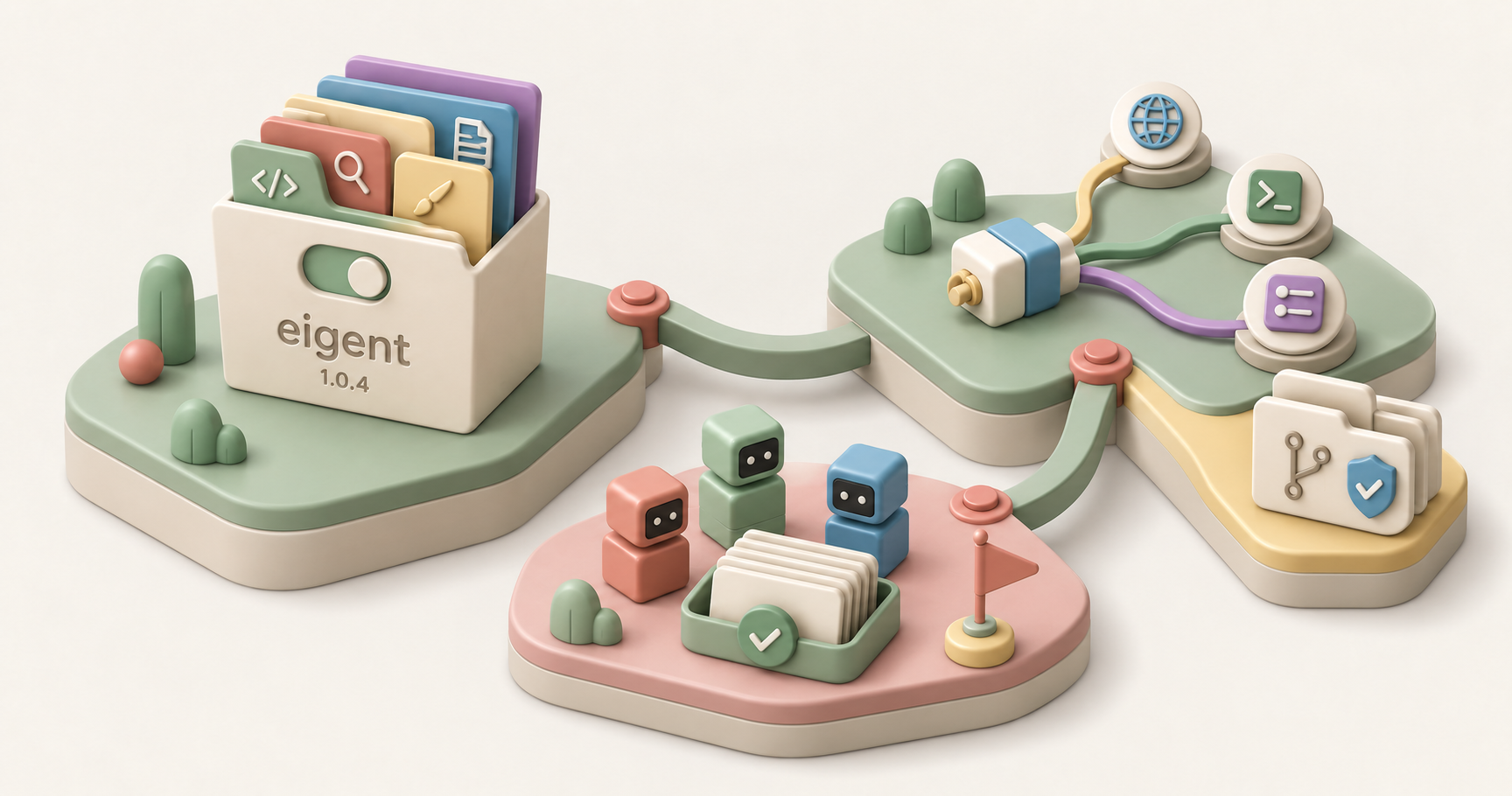
Eigent Release Notes v1.0.4: Skills & Connectors Dashboards, Durable Multi-Turn Runs
Eigent v1.0.4 rebuilds Skills and Connectors as management dashboards and strengthens multi-turn agent work, workspace checkpoints, and connector states.
Douglas Lai
Claude Fable 5.1 and Mythos 5.1: What's New, Explained
Claude Fable 5.1 and Mythos 5.1 explained: the same model in two safeguard tiers, with new benchmarks, roughly 25 to 45 percent lower cost, and access details.
Eigent


