Clay AI Alternative — Open Source GTM Engineering
Own the GTM orchestration layer while keeping the real cost of enrichment data, CRM integration, deliverability, models, and operator time visible.
 Douglas Lai
The honest open-source Clay AI alternative replaces the orchestration layer, not Clay's data marketplace. Eigent can coordinate web research, buyer-owned enrichment APIs, scoring, personalization, approvals, and CRM updates. It does not bundle Clay's 150+ providers, normalized waterfalls, signals, table-centric GTM interface, sending infrastructure, or managed enterprise support. The decision is control and composability versus packaged data access and operations.
Quick verdict
- Keep Clay when its provider marketplace, waterfall logic, table UX, signals, and managed CRM/data-warehouse connections are central to the workflow.
- Use Eigent when application source, local orchestration, provider choice, and custom cross-system logic justify more engineering.
- Use a hybrid when Clay remains the enrichment market but Eigent owns research, analysis, documents, and downstream approvals.
- Do not treat open source as permission to scrape or contact people. Data contracts, privacy law, suppression lists, deliverability, and channel rules still apply.
Clay pricing now uses two meters
Clay moved from one credit system to Actions plus Data Credits in March 2026. Its pricing memo lists Free at $0, Launch at $185 per month, Growth at $495, and Enterprise at a custom price (Clay pricing memo).
| Tier | Starting monthly price | Actions/month | Data Credits/month | Important gate |
|---|---|---|---|---|
| Free | $0 | 500 | 100 | 200 rows per table; no phone enrichment |
| Launch | $185 | 15,000 | 2,500 | Signals, phone enrichment, sequencing integrations; no native CRM/HTTP API |
| Growth | $495 | 40,000 | 6,000 | CRM sync, HTTP API/webhooks, web intent, data warehouse |
| Enterprise | Custom | Custom | Custom | Bulk enrichment, SSO/RBAC, controls, and support |
Actions meter orchestration such as enrichment calls, AI tasks, API calls, and pushes. They reset each billing cycle and do not roll over. Data Credits purchase data and AI through Clay's marketplace; Launch and Growth credits can accumulate up to twice the monthly allocation, while top-ups carry a 30% premium (Clay pricing).
Bringing your own data or model key removes the Clay Data Credit charge for that call, but it still uses an Action and creates a separate vendor bill. Clay says a fully enriched record typically uses 6–20 Data Credits depending on the data, key ownership, and waterfall depth (Clay Actions and Data Credits documentation).
Why Clay gets expensive—and why it can still be worth it
The two-meter model improves the separation between orchestration and data, but it also makes forecasting more involved. Clay's own internal pricing memo identified complexity and reduced experimentation as risks while saying 90% of customers should remain below the default Action limits (Clay pricing memo).
The total stack can include:
- Clay tier and Actions;
- Data Credits or direct provider contracts;
- model usage;
- CRM, data warehouse, and sequencer tools;
- domains, mailboxes, validation, and deliverability;
- implementation, list QA, and GTM engineering time.
A single May 2026 Trustpilot reviewer alleged unexpected credit consumption and a problem with a bring-your-own-key workflow (Trustpilot). That is one unaudited report, not a verified defect rate. G2's current aggregation was 4.7/5 across more than 200 reviews, with praise for waterfalls and integrations alongside price concerns (G2). Review platforms are directional, not representative samples.
Clay's data moat is more than an API loop
Clay packages access to more than 150 data and AI providers, normalizes their outputs into a table model, runs waterfalls, shows cost before enrichment, and adds audiences, signals, CRM sync, data-warehouse integration, and enterprise controls (Clay pricing, Clay docs).
Some providers can be called through a buyer's own account. Others require contracts, minimums, permitted-use rules, normalization, identity matching, and fallback logic. An open orchestrator cannot copy those commercial relationships.
| Layer | Replaceable with Eigent plus APIs? | Caveat |
|---|---|---|
| Web and company research | Often | Quality, provenance, anti-bot terms, and model cost vary |
| Buyer-owned enrichment API | Yes | Provider fee and data license remain |
| Multi-provider waterfall | Buildable | Routing, deduplication, confidence, and cost controls are engineering work |
| Clay marketplace contracts | No direct substitute | Buyer must contract and govern providers |
| CRM read/write | Yes, with connectors | Permissions, idempotency, retries, and schema drift matter |
| Deliverability and mailboxes | No | Retain a purpose-built sending stack |
| Signals catalog | Partial | Depends on licensed inputs and monitoring connectors |
| Governance and support | Not equivalent | Open deployment is operator-owned |
Clay AI alternative vs an Eigent-based stack
Eigent is an Apache-2.0 multi-agent workspace that can coordinate research, transformations, scoring, API enrichment, drafted personalization, approvals, and system updates (Eigent repository). It is an orchestration application, not a prospect database or sending network.
| Cost component | Clay stack | Eigent-based stack |
|---|---|---|
| Orchestration | Clay plan plus Actions | App license free; infrastructure and operator time |
| Enrichment data | Data Credits or BYO providers | BYO contracts and API usage |
| LLM research | Clay fixed/variable models or BYO | Hosted model API or local compute |
| CRM integration | Growth or Enterprise features | Connector development and maintenance |
| Sequencing/deliverability | Clay Sequencer/integrations plus sender stack | Separate purpose-built sender stack |
| Governance/support | Higher-tier product and services | Self-managed unless separately contracted |
Eigent wins on source access, local/self-hosted control, general agent collaboration, and provider choice. Clay wins on the curated marketplace, table-centric GTM experience, prebuilt waterfalls and signals, normalization, managed integrations, and support.
Build a controlled GTM workflow
Use a permissioned source list and one narrow objective.
- Ingest the source list. Preserve source, consent or lawful-basis metadata, suppression status, and owner.
- Normalize records deterministically. Standardize domains and company identifiers before paying for enrichment.
- Call buyer-owned providers. Apply per-provider budgets, retries, timeouts, and data-use restrictions.
- Run a waterfall. Stop once required fields meet a confidence threshold; record every provider and cost.
- Research from attributable sources. Keep URLs and timestamps for factual claims.
- Score with an explicit rubric. Separate deterministic criteria from model judgment.
- Draft, then approve. Do not allow a model to send outreach automatically during the pilot.
- Update the CRM idempotently. Use stable external IDs, change logs, and a rollback path.
- Measure accepted data. Track match rate, bounce rate, duplicate rate, manual correction, cost per accepted record, and reply quality.
Eigent can support the orchestration and review path. The sales Cowork solution and contract-renewal pipeline show adjacent controlled workflows.
How to migrate from Clay
Export tables and logic
Export data, formulas, prompts, waterfall order, score definitions, views, and downstream mappings. Preserve provider provenance and timestamps where licenses permit.
Inventory every provider contract
List which calls use Clay marketplace access and which use your own keys. Confirm whether exported data can be retained, reused, or transferred under each provider's terms.
Rebuild one waterfall
Start with one stable enrichment flow. Add deduplication, confidence, budget ceilings, and fallbacks before layering AI research or personalization.
Shadow CRM writes
Generate proposed changes without writing them. Compare fields, ownership, stage rules, and duplicates against real RevOps expectations.
Move sending last
Keep the existing deliverability stack until research and CRM updates are stable. Mailbox reputation, warming, bounce control, unsubscribe processing, and suppression are separate operating systems.
Who should keep, augment, or replace Clay?
Keep Clay if marketplace access, fast waterfall configuration, and managed GTM integrations save more than the tier and credit cost.
Augment Clay if the data plane works but research, document production, approvals, or cross-functional workflows need a more general multi-agent layer.
Replace the orchestration layer if source ownership, self-hosting, custom logic, or provider portability are hard requirements and your team can maintain the stack.
Clay announced a January 2026 employee tender at a $5 billion valuation, allowing up to $55 million of shares to be sold; this was a tender valuation, not a new primary financing round (Clay announcement). The company's scale and continued investment are reasons to evaluate the product on current capability, not to assume an open rebuild is automatically better.
For the broader build-versus-buy picture, see /blog/best-open-source-ai-sales-agents.
Own orchestration without pretending data is free
Eigent can make the GTM workflow inspectable and provider-flexible, but every enrichment source, model, CRM, and sending system retains its own cost and rules. Start with a reversible contract-renewal pipeline, then measure data accuracy and operator time before replacing Clay. Download Eigent to run the pilot on a permissioned sample.
Recent Posts
Meta Muse: The Personal AI Agent That Books, Buys, and Negotiates
Meta Muse is a personal AI agent that books travel, buys things, and negotiates bills from a chat. Here's what it does, pricing, security, and how it compares.
 Eigent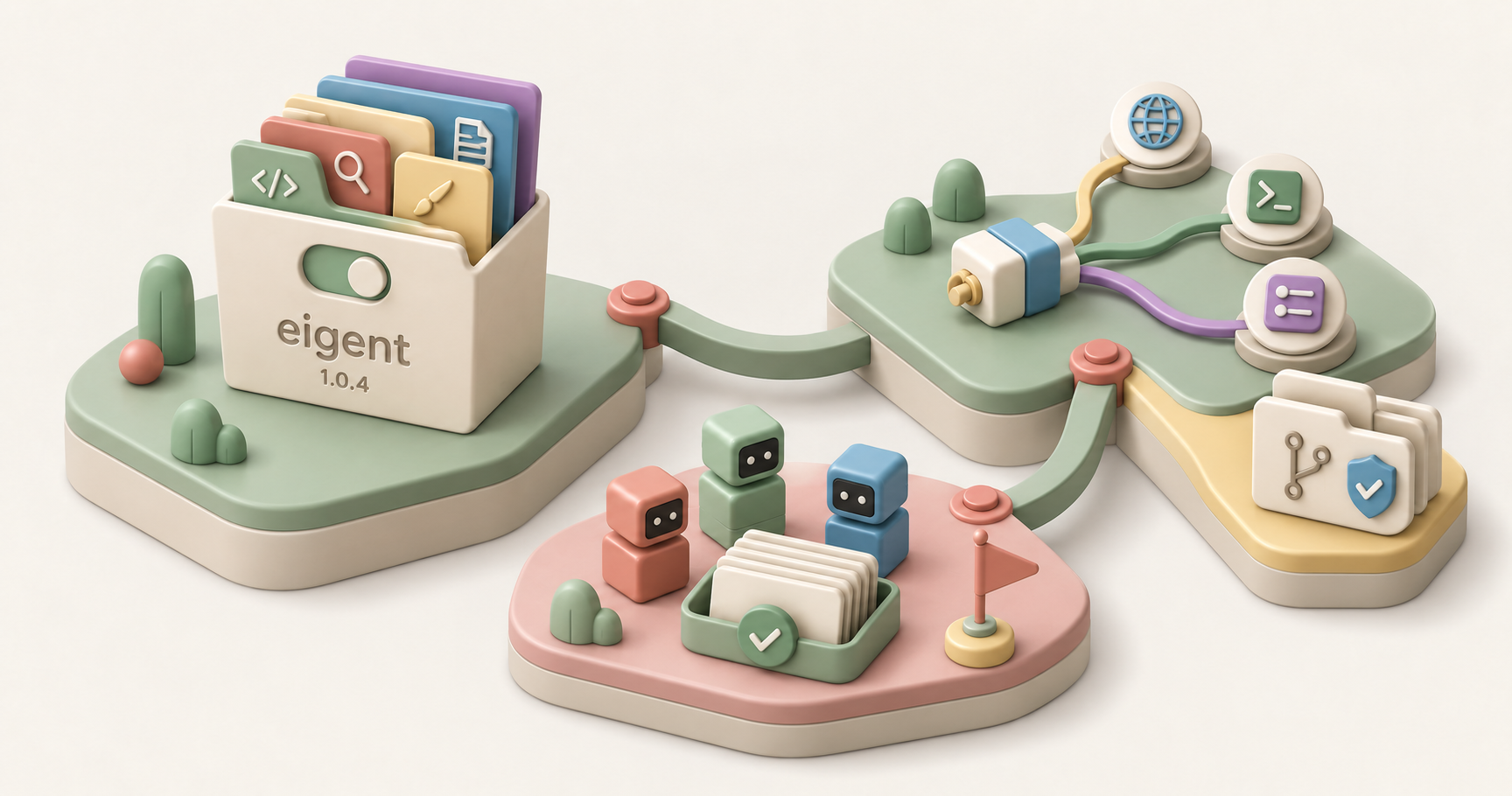
Eigent Release Notes v1.0.4: Skills & Connectors Dashboards, Durable Multi-Turn Runs
Eigent v1.0.4 rebuilds Skills and Connectors as management dashboards and strengthens multi-turn agent work, workspace checkpoints, and connector states.
Douglas Lai
Claude Fable 5.1 and Mythos 5.1: What's New, Explained
Claude Fable 5.1 and Mythos 5.1 explained: the same model in two safeguard tiers, with new benchmarks, roughly 25 to 45 percent lower cost, and access details.
Eigent


