
Poolside AI Alternative — Self-Hosted Coding Models
Compare Poolside’s sovereign enterprise model stack with an open orchestration layer and a coding model you choose, deploy, evaluate, and operate.
 Douglas Lai
A Poolside AI alternative must start by comparing the right layer. Poolside sells coding foundation models and enterprise deployment; Eigent is an open multi-agent application that can call a model. The honest alternative is therefore Eigent plus a coding model you choose, not Eigent instead of a model. Poolside is stronger when a buyer needs contracted full weights, government support, hardware optimization, and an enterprise air-gapped delivery.
Quick comparison
| Dimension | Poolside | Eigent-based stack |
|---|---|---|
| Product | Coding models plus enterprise deployment | Multi-agent application/harness plus chosen model |
| Weights | Full weights for contracted deployments | No bundled frontier weights |
| Application source | Not verified as open source | Eigent is Apache-2.0 (repository) |
| Deployment | On-premises and air-gapped enterprise | Local/self-hosted app; model boundary depends on setup |
| Pricing | Contact sales | App license free; model, infrastructure, and operations separate |
| Model choice | Poolside model family | Multiple compatible hosted or local models |
| Support | Enterprise and government delivery | Community/open-source path plus available Eigent offerings |
Choose Poolside when model capability, contracted weight delivery, and vendor accountability matter more than multi-model portability. Choose an Eigent stack when you want to own the application layer and can source, evaluate, and operate the model separately.
What Poolside AI sells
Poolside was founded by former GitHub CTO Jason Warner and Eiso Kant. Its 2024 $500 million Series B brought total funding to $626 million and valued the company at $3 billion (TechCrunch).
The product is aimed at enterprise coding intelligence rather than consumer pair programming. Poolside currently markets full model weights for on-premises and air-gapped government deployments, with no per-token Poolside cloud fee once the model runs on customer-owned hardware (Poolside government page).
A May 2026 Dell partnership post argues that on-premises inference can make agent cost more predictable than metered cloud consumption (Poolside). That is Poolside's commercial argument, not a universal proof that on-premises inference is cheaper for every workload.
Reported 2025 talks around a proposed $2 billion financing at a $12 billion valuation should not be treated as a closed round. TechCrunch, citing Bloomberg, reported that Nvidia was considering a $500 million to $1 billion investment as part of those talks (TechCrunch).
Full weights are not automatically open source
Poolside's government materials promise full model weights for contracted deployments. That supports sovereign inference. It does not establish OSI-style open-source rights to modify, redistribute, or reconstruct the model.
Procurement should review:
- the weight license and permitted users;
- modification and fine-tuning rights;
- redistribution and derivative restrictions;
- training-data information and indemnity;
- export-control and geography limits;
- termination, escrow, and continued-use rights;
- support for specific accelerators and serving stacks.
The Open Source Initiative's AI definition expects more than downloadable parameters, including information and code needed to modify the system (OSI definition). “Full weights” and “open source” should remain separate claims unless the contract and release meet that standard.
What sovereign inference really costs
Poolside says contracted government deployments avoid per-token Poolside cloud charges (Poolside government page). Buyers still pay for the model contract, servers, accelerators, power, cooling, networking, storage, support, platform engineering, security, and utilization risk.
Model total cost across these categories:
| Cost | Questions to ask |
|---|---|
| Model rights | Is pricing based on capacity, users, sites, term, or support? |
| Hardware | Which accelerators, memory, interconnect, and redundancy are required? |
| Serving | Which runtime, quantization, batching, and context lengths are supported? |
| Operations | Who patches drivers, images, kernels, and model servers? |
| Evaluation | Which private repositories and tasks define acceptable quality? |
| Security | How are weights, prompts, source code, logs, and admin access protected? |
| Availability | What capacity and failover are needed during peaks? |
On-premises economics improve when utilization is stable and the organization already operates accelerator infrastructure. They can be poor when expensive hardware sits idle or a small team needs only intermittent coding assistance.
Where Eigent fits
Eigent is an Apache-2.0 multi-agent workspace, not a foundation-model vendor (Eigent repository). It can provide the application layer that assigns tasks, calls a compatible model endpoint, executes scoped tools, and coordinates coding with browser, terminal, research, and document work.
That creates three genuine advantages:
- Application source access. Teams can inspect and modify orchestration behavior.
- Model portability. A compatible hosted or local endpoint can be changed without replacing the whole workspace.
- No mandatory enterprise contract for the app. The operator still pays for model, infrastructure, and support.
The gaps are large. Eigent does not train a frontier coding model, deliver contracted full weights, optimize an enterprise GPU stack, or provide Poolside's government procurement and support package. It should not be presented as matching Poolside model quality without a reproducible head-to-head test.
Build a smaller self-hosted coding stack
For teams below Poolside's likely enterprise procurement threshold, an open application plus a chosen model may be more practical.
1. Select the harness
Use Eigent for cross-functional multi-agent work, OpenHands for asynchronous software-agent infrastructure, Cline for an IDE approval loop, or Aider for direct Git supervision. Their licenses and roles are compared in /blog/best-open-source-ai-coding-agents-2026.
2. Choose a model from measured needs
Start with a model that fits your hardware and private evaluation set. Do not assume every open-weight release is laptop-friendly. Kimi K2's official model card, for example, lists one trillion total parameters and a Modified MIT release (Kimi K2 model card).
3. Isolate repository access
Run the harness as a non-admin identity in a container or VM. Mount only the test repository, remove production secrets, and restrict network egress.
4. Evaluate the full loop
Test bug fixes, multi-file refactors, test generation, dependency updates, and code explanation. Record model accuracy, reviewer time, latency, context failures, cost, attempted boundary violations, and rollback behavior.
5. Add concurrency last
One useful model session does not prove that several agents can run at once. Concurrency increases memory, KV-cache, throughput, and scheduling requirements. Size from measured parallel workloads.
For the detailed deployment path, see /blog/self-hosted-ai-coding-agent.
When Poolside wins
Poolside is the stronger choice when the buyer requires contracted full-weight delivery, air-gapped government support, enterprise hardware integration, vendor accountability, and a model trained specifically for software work. Those are model-and-delivery capabilities an open application cannot substitute.
An Eigent stack wins when the organization already has a suitable model endpoint, wants to switch among models, needs source access at the orchestration layer, or is too small for a bespoke model contract.
Procurement checklist
Before choosing either route, ask:
- Which layer do we need: model, agent application, or both?
- Must weights be downloadable, modifiable, or merely deployable on premises?
- What source and telemetry may leave the environment?
- What private tasks define acceptable coding quality?
- What hardware utilization makes on-premises economics credible?
- Who owns upgrades, incident response, evaluation, and rollback?
- Can prompts, policies, logs, and indexes be exported if the vendor changes?
Own the application, choose the model
Eigent is not a Poolside model replacement; it is the open orchestration layer that lets you connect a model without locking the entire workflow to it. Use it to run a controlled large-codebase analysis workflow, then compare the same evaluation set across candidate endpoints. Download Eigent to test the application layer before making a model-infrastructure commitment.
Recent Posts
Meta Muse: The Personal AI Agent That Books, Buys, and Negotiates
Meta Muse is a personal AI agent that books travel, buys things, and negotiates bills from a chat. Here's what it does, pricing, security, and how it compares.
 Eigent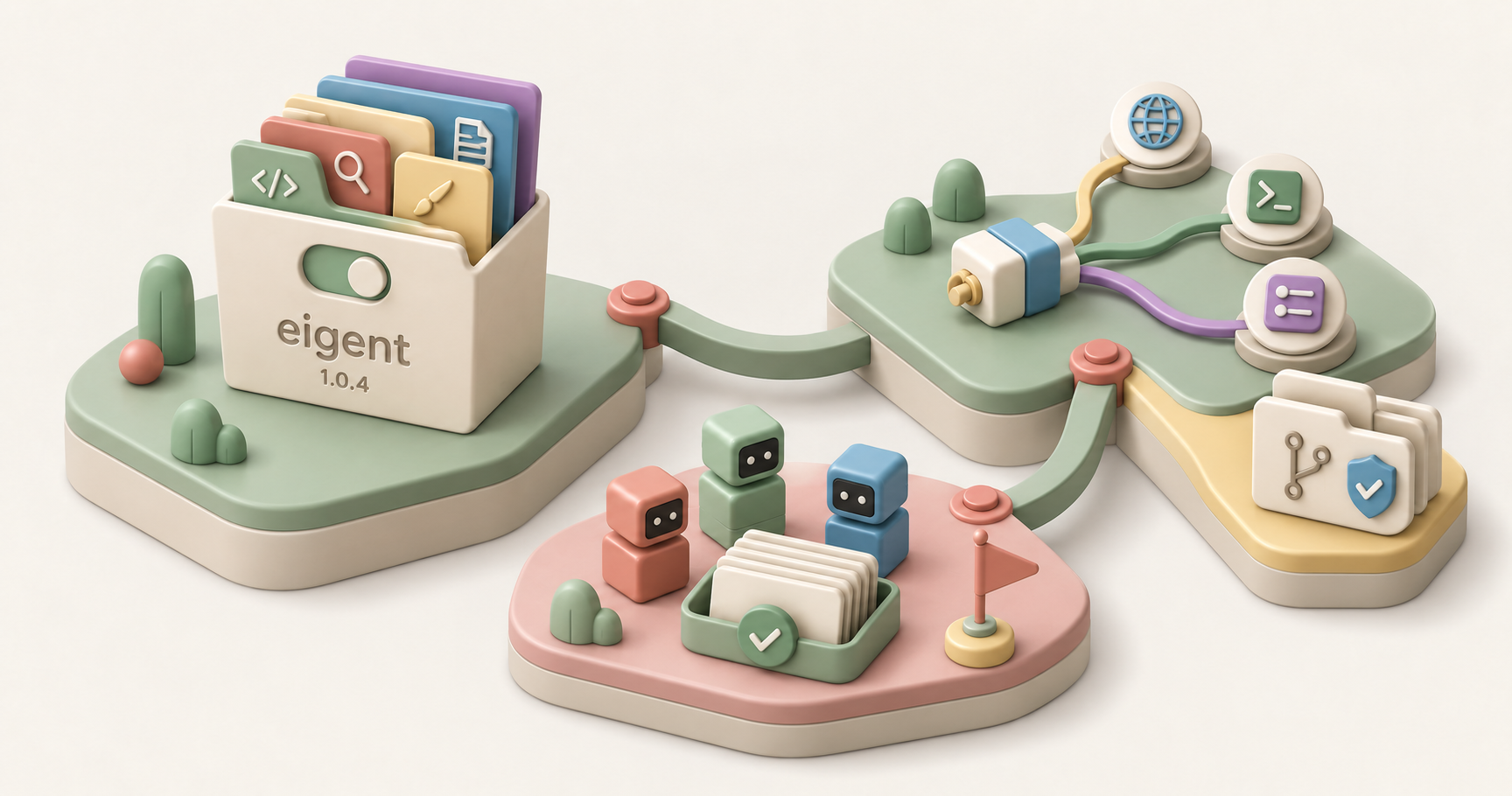
Eigent Release Notes v1.0.4: Skills & Connectors Dashboards, Durable Multi-Turn Runs
Eigent v1.0.4 rebuilds Skills and Connectors as management dashboards and strengthens multi-turn agent work, workspace checkpoints, and connector states.
Douglas Lai
Claude Fable 5.1 and Mythos 5.1: What's New, Explained
Claude Fable 5.1 and Mythos 5.1 explained: the same model in two safeguard tiers, with new benchmarks, roughly 25 to 45 percent lower cost, and access details.
Eigent


